

Florida Quitclaim Deed: Requirements, Cost, and How to File

A Florida quitclaim deed transfers whatever interest the grantor holds in real property to the grantee, with no warranty of title. The grantee takes exactly the interest the grantor owned, subject to every mortgage, lien, and title defect attached to it. In Florida, the quitclaim deed is the standard instrument for transfers between people who already know each other.
Property owners use quitclaim deeds for non-sale transfers: between family members, into trusts and LLCs, and after a divorce. A sale to an unrelated buyer calls for a warranty deed, because a buyer paying market price needs the title guarantees a quitclaim deed omits.
Requirements for a Valid Quitclaim Deed in Florida
A valid Florida quitclaim deed must be signed by the grantor before two witnesses and a notary public; the grantee does not sign. If the property is the grantor’s homestead and the grantor is married, the spouse must also sign any deed to a third party, even when the spouse’s name has never appeared on the title.
A Florida quitclaim deed contains these elements:
- Grantor. The full legal name of the person transferring the interest, written exactly as it appears on the current recorded deed.
- Grantee. The full legal name of the person receiving the interest, plus the ownership form when more than one grantee takes title (joint tenancy, tenancy in common, or tenancy by the entireties for a married couple).
- Consideration. A recital of what the grantee gives for the transfer. Family transfers usually recite a nominal amount, such as ten dollars, and many deeds recite good and valuable consideration without naming a figure.
- Legal description. The lot-and-block, metes-and-bounds, or condominium description from the current recorded deed. A street address does not satisfy this requirement.
- Parcel identification number. The number the county property appraiser assigns to the property. Florida’s quitclaim deed statute, section 689.025, calls for a blank space for the parcel number and states that omitting it does not affect the deed’s validity or recordability.
- Grantor’s signature, two witnesses, and a notary acknowledgment. Both witnesses must watch the grantor sign and must sign in the grantor’s presence. Florida permits remote online notarization, with signing and witnessing completed over an audio-video link.
Florida’s recording statute adds formatting rules. Under section 695.26, each signer’s name must be printed beneath the signature, and the two witnesses’ names and mailing addresses must appear beneath their signatures. The deed must also name its preparer, with a mailing address, and state the grantee’s mailing address. The first page needs a blank 3-inch square at its top right corner for the clerk’s recording stamp. Each page after the first needs a blank 1-inch by 3-inch space at its top right corner as well.
The witness address requirement took effect January 1, 2024. Clerks reject deeds prepared on older forms that omit it. A deed rejected for formatting still binds the parties who signed it; correcting the formatting and resubmitting makes it eligible for recording.
County records across Florida contain deeds recorded under the misspelled caption “quick claim deed.” The misspelling has no legal effect. Validity turns on the granting language, the legal description, and proper execution. A deed that satisfies those requirements conveys the grantor’s interest under any caption.
Get a Quitclaim Deed
Attorney Gideon Alper prepares quitclaim deeds for clients throughout Florida. We handle the drafting, execution, and recording.
Schedule Online
Common Uses for a Quitclaim Deed in Florida
Most Florida quitclaim deeds move title between family members or between an owner and the owner’s own trust or LLC. The most common transfers:
- Adding a spouse after marriage. A deed from one spouse into both spouses’ names creates tenancy by the entireties, the ownership form Florida reserves for married couples. Each spouse owns the whole property. The survivor automatically takes full title when the first spouse dies.
- Removing a former spouse after divorce. Marital settlement agreements and dissolution judgments routinely order one spouse to deed an interest to the other. A quitclaim deed completes the obligation.
- Funding a revocable living trust. Deeding a home into a Florida revocable living trust moves legal title from the individual to the trustee, which keeps the property out of probate.
- Moving rental property into an LLC. An owner who transfers real estate into a Florida LLC uses a quitclaim deed because the owner has no reason to warrant title to a company the owner controls.
- Adding or removing a family member. Parents putting an adult child on title, siblings consolidating an inherited property, and owners correcting a name on a prior deed all use quitclaim deeds.
- Clearing a cloud on title. A quitclaim deed from a person with a stale or arguable interest (a former co-owner, an old judgment holder, a possible heir) releases whatever interest that person may have, without any admission that the interest existed.
How to File a Quitclaim Deed in Florida
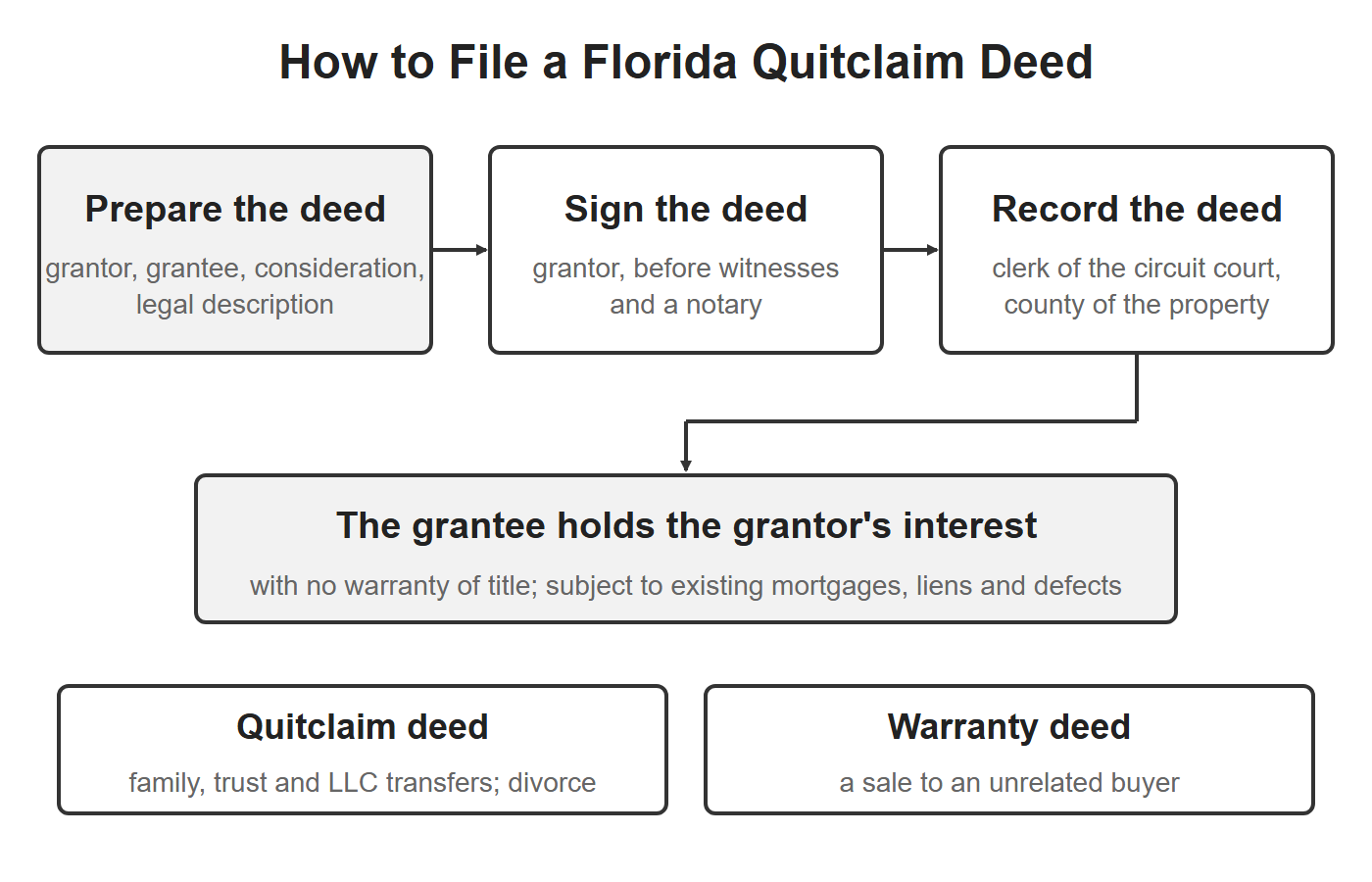
Filing a Florida quitclaim deed takes three steps: prepare the deed, sign it before two witnesses and a notary, and record it with the clerk of the circuit court in the county where the property is located.
Step 1: Prepare the deed. Use a Florida-specific form that follows the statutory format and includes the parcel number blank. Copy the legal description from the current recorded deed or the property appraiser’s records, then paste and proofread it. Fixing a transposed lot number later takes a corrective deed or a quiet title action.
Step 2: Sign the deed. The grantor signs before two witnesses and a notary, with everyone physically present together or connected on one audio-video link under Florida’s remote online notarization rules. The witnesses must be competent adults. A person named in the deed as a party should not also sign as a witness. The notary completes the acknowledgment after identifying the grantor by personal knowledge or government-issued photo identification.
Step 3: Record the deed. Deliver the executed original to the clerk of the circuit court in the property’s county. The clerk collects the recording fee and any documentary stamp tax, enters the deed into the official records, and returns the original to the address in its top left corner. The clerk checks formatting and fees only, so a defective deed records as easily as a valid one. Keep the recorded original, because future title work depends on it.
The transfer itself becomes effective when the grantor delivers the signed deed to the grantee. Recording then protects the grantee’s ownership against outside claims. An unrecorded deed leaves the grantee exposed to any later purchaser, lender, or lienholder who records first. Florida’s recording statute, section 695.01(2), treats a quitclaim grantee as a bona fide purchaser (a buyer who takes without notice of competing claims), so a quitclaim grantee who records first generally defeats an earlier unrecorded interest.
How Much Does a Quitclaim Deed Cost in Florida?
A self-prepared Florida quitclaim deed costs under $35 in government charges for a simple transfer. Recording runs $10 for the first page and $8.50 for each additional page. A deed reciting nominal consideration with no mortgage owes a minimum documentary stamp tax of 70 cents.
An attorney-drafted quitclaim deed adds a legal fee, typically $400 to $750 in Florida. Many county clerks publish fillable quitclaim deed forms on their websites, so a person handling a simple transfer without an attorney pays the government charges and little else.
Documentary stamp tax is the variable cost. Section 201.02 of the Florida Statutes sets the rate: 70 cents per $100 of consideration. Consideration includes any mortgage balance the property carries, whether or not the grantee formally assumes the loan. Quitclaiming a home with a $300,000 mortgage to a non-spouse generates $2,100 in tax even if no money changes hands.
Miami-Dade County uses different rates: 60 cents per $100 for a single-family residence, and 60 cents plus a 45-cent surtax per $100 for any other property.
Transfers Exempt from Documentary Stamp Tax
Florida law exempts several common quitclaim transfers from documentary stamp tax:
- Divorce transfers of the marital home. Deeds between spouses or former spouses that carry out a dissolution of marriage owe no tax on the marital home, regardless of any mortgage balance. Tax already paid on a deed recorded up to one year before the dissolution is refundable.
- Homestead transfers between spouses. A deed moving homestead property between spouses owes no tax when the only consideration is a mortgage or another lien already on the property. The exemption covers three directions: one spouse to the other, one spouse to both, and both spouses to one. Adding a spouse to the title of a mortgaged homestead therefore carries no documentary stamp tax.
- Funding the owner’s revocable trust. Deeding an unencumbered home into the owner’s own revocable living trust owes only the minimum tax, because beneficial ownership stays with the grantor and no consideration changes hands.
- Moving unencumbered property into the owner’s own LLC. With no mortgage and no payment, there is no taxable consideration beyond the minimum. A mortgage changes the result. The balance counts as consideration even when the owner controls the company receiving the deed.
Can You Prepare Your Own Quitclaim Deed in Florida?
Florida law allows property owners to prepare and record their own quitclaim deeds without an attorney, and county clerks accept self-prepared deeds that meet the formatting rules.
Self-prepared deeds cause problems when something about the property or the parties makes the standard form insufficient. A married grantor deeding homestead property to a third party needs the spouse’s signature even when the spouse holds no recorded interest. A transfer of mortgaged property to a non-spouse triggers documentary stamp tax on the loan balance and can violate the mortgage’s due-on-sale clause. A married couple taking title together should confirm the deed identifies them as married. An express designation as tenants by the entireties removes any doubt about the ownership form.
When any of those situations applies, the legal fee for an attorney-drafted deed is small compared to the cost of curing a defective transfer. A drafting error takes a corrective deed; a void homestead conveyance takes a new deed signed by both spouses, and a disputed one takes litigation.
Florida Quitclaim Deed Form
The sample below is a Florida quitclaim deed, which conveys whatever interest the grantor holds and warrants nothing about the title. Its brackets hold the language for homestead property, a joining spouse, and a recital that cancels a lady bird deed already on record.
Download this form: Word (.docx) | PDF · Part of our asset protection forms library.
Does a Quitclaim Deed Give You Ownership?
A quitclaim deed makes the grantee the legal owner of whatever interest the grantor held, effective the moment the grantor delivers the signed deed.
The quality of that ownership matches what the grantor had. Full, unencumbered title in the grantor’s hands becomes full, unencumbered title in the grantee’s. Title burdened by a mortgage, judgment lien, or chain-of-title defect passes with those burdens intact.
Ownership brings exposure along with it. Once the grantee is on title, the property becomes an asset the grantee’s own judgment creditors can reach. It can also become part of the grantee’s marital estate in a later divorce. How a new owner takes title is a Florida asset protection decision. Tenancy by the entireties protects a married couple from either spouse’s separate creditors, and a properly structured trust or LLC separates legal ownership from personal exposure.
How Long Is a Quitclaim Deed Good For?
A Florida quitclaim deed does not expire. The transfer is complete when the deed is delivered. The grantee’s ownership continues indefinitely with no renewal or refiling.
The transfer is just as permanent for the grantor. A quitclaim deed cannot be revoked after delivery, even the next day. Undoing a completed transfer requires either a new deed from the grantee conveying the interest back or a lawsuit to set the deed aside on grounds such as fraud, duress, undue influence, or lack of capacity. The burden falls on the person challenging the deed.
How to Add a Name to a Deed in Florida
Adding a name to a Florida deed takes a new quitclaim deed from the current owner to the owner and the new co-owner together. The owner is the grantor and one of the grantees, and only the grantor signs. The person being added signs nothing.
The deed should say how the co-owners will hold title, because that choice sets both the creditor protection and what happens when one owner dies. Florida recognizes three forms:
- Tenancy by the entireties. Married couples only. The separate creditors of either spouse cannot reach the property. The surviving spouse takes full title without probate. A deed from the titled spouse to both spouses creates the tenancy by the entireties under section 689.11, with no third-party straw man.
- Joint tenancy with right of survivorship. Two or more owners, related or not. The survivors take a deceased owner’s share automatically, but the property stays exposed to each owner’s separate creditors.
- Tenancy in common. Each owner holds a separate, divisible share with no survivorship. A deceased owner’s share passes through that owner’s estate.
A deed that says nothing about survivorship creates a tenancy in common under section 689.15. The exception is a deed to a married couple, which Florida presumes to create a tenancy by the entireties unless the deed says otherwise, even when the deed does not describe the grantees as spouses. Naming the ownership form in the deed removes the argument either way.
Adding an Adult Child to a Deed
Putting an adult child on a Florida deed is a lifetime gift of the child’s share. The gift cannot be undone without the child’s consent. It costs the parent three things a lady bird deed keeps: control of the property, protection from the child’s creditors, and the full stepped-up basis at death.
The child’s share sits outside the parent’s homestead protection. A judgment creditor of the child can levy on that share and sell it. The buyer, as a new co-owner, can force a partition sale of the whole property. Homestead does not stop a partition suit brought by a co-owner.
A child who takes as a tenant in common keeps the parent’s original cost basis on that share. When the home sells, the child owes capital gains tax on the appreciation since the parent bought it. A joint tenancy with right of survivorship can reverse that result. Because the parent supplied all the consideration, federal law puts the whole property back in the parent’s estate at death, and the survivor’s basis steps up with it.
The gift also has tax, Medicaid, and mortgage consequences:
- Gift tax. A gift of a share worth more than the $19,000 annual exclusion for 2026 requires a federal gift tax return, though tax is rarely owed against the $15 million lifetime exemption.
- Medicaid. A lifetime gift starts Medicaid’s five-year look-back for the parent.
- Documentary stamp tax. The tax typically falls on the child’s proportionate share of any mortgage balance.
- The mortgage. The loan stays in the parent’s name. On a residential loan of fewer than five units, the Garn-St. Germain Act keeps the lender from treating a transfer to the borrower’s child as a default under a due-on-sale clause.
Adding a child does not by itself end the Save Our Homes cap. The cap stays in place as long as the parent remains on title and keeps the homestead exemption. It resets if the child applies for a separate homestead exemption, and an outright gift of the whole home resets it as well. The property appraiser then reassesses the home at market value the following January 1.
A child who does not live in the home and takes as a tenant in common also shrinks the exemption to the parent’s proportionate share of the assessed value. Title held by the entireties or with right of survivorship keeps the full exemption.
How to Remove a Name from a Deed in Florida
Removing a name from a Florida deed requires the person coming off the title to sign a quitclaim deed conveying that interest to the remaining owners. No owner can remove another owner without that signature. A co-owner who refuses leaves the others one route, a partition action under section 64.031, which asks the court to divide the property or sell it and split the proceeds. Partition is a lawsuit that can take months and cost thousands of dollars in attorney fees.
Property inherited by several family members falls under Florida’s heirs property statute instead. The court values the property, gives the other co-owners the first right to buy out the one who filed, and prefers dividing the land over selling it.
A quitclaim deed removes a name from the title only. The person coming off the deed stays liable on any mortgage they signed until the loan is refinanced or the lender releases them in writing. A deed between spouses is simpler. Section 689.11 lets one spouse convey homestead to the other, or to both spouses together, with no signature from the receiving spouse. When the only consideration is a mortgage already on the property, that deed owes no documentary stamp tax.
Removing a Deceased Owner’s Name
A deceased co-owner’s name comes off the record without a new deed when title was held by the entireties or as joint tenants with right of survivorship. The survivor records a certified death certificate that omits the cause of death, together with Form DR-312, the affidavit of no Florida estate tax due. The affidavit releases the estate tax lien even though Florida has collected no estate tax on deaths after 2004.
Title companies also ask a surviving spouse for an affidavit of continuous marriage. A non-identification affidavit is sometimes needed as well, when someone with a similar name carries judgments in the public records. Clearing the record this way typically costs $750 to $1,200 in attorney fees and recording charges.
A tenancy in common share has no survivorship. Where the property was the decedent’s protected homestead, the share passes to the heirs by operation of law, and the usual clearing document is a court order determining homestead status. A share that was not protected homestead is administered in the estate. The personal representative conveys it under a power of sale in the will or with court authorization.
Quitclaim Deeds After a Florida Divorce
A Florida divorce settles the marital home with a quitclaim deed from the departing spouse to the spouse who keeps it. The marital settlement agreement or the final judgment orders the deed, and the departing spouse signs it as grantor. The receiving spouse signs nothing.
Under section 201.02(7)(a), the deed owes no documentary stamp tax on the marital home when it carries out a dissolution of marriage, whatever the mortgage balance. Tax paid on a deed recorded up to a year before the dissolution is refundable. The exemption reaches the marital home only, so a divorce transfer of a rental or vacation home is taxed on any mortgage balance that supplies the consideration.
The deed does not touch the mortgage. A spouse who deeds away the home stays liable on the loan until it is refinanced into the other spouse’s name or the lender grants a written release. The lender has no obligation to release the departing spouse. Federal law does protect the transfer itself. Under the Garn-St. Germain Act, a lender may not call a residential loan of fewer than five units because the property passed to a former spouse under a divorce decree or marital settlement agreement.
The transfer does not reset the Save Our Homes cap either. Florida’s assessment statute treats a transfer on dissolution of marriage as no change of ownership, so the spouse who keeps the home keeps the capped assessed value.
What Are the Disadvantages of a Quitclaim Deed?
The main disadvantage of a quitclaim deed is that the grantee receives no guarantee of title. A warranty deed guarantees clear title and makes the grantor personally liable for defects discovered after the transfer. A quitclaim deed conveys the interest as-is, and the grantee bears any title problem that surfaces.
Warranty deeds are the standard instrument for arm’s-length purchases, mortgage-financed transactions, and any transfer where the buyer wants recourse against the seller if the title proves defective.
Florida title insurance companies routinely insure property conveyed by quitclaim deed. The deed type by itself does not disqualify a property from coverage. The buyer’s protection comes from the title examination and the owner’s policy. A buyer who takes a quitclaim deed from a stranger without either one has no warranty from the grantor and no insurance behind the title. A defect discovered later can block a sale or refinance until it is cured.
Alper Law has structured offshore and domestic asset protection plans since 1991. Schedule a consultation or call (407) 444-0404.
