ITF Bank Accounts and Creditor Protection

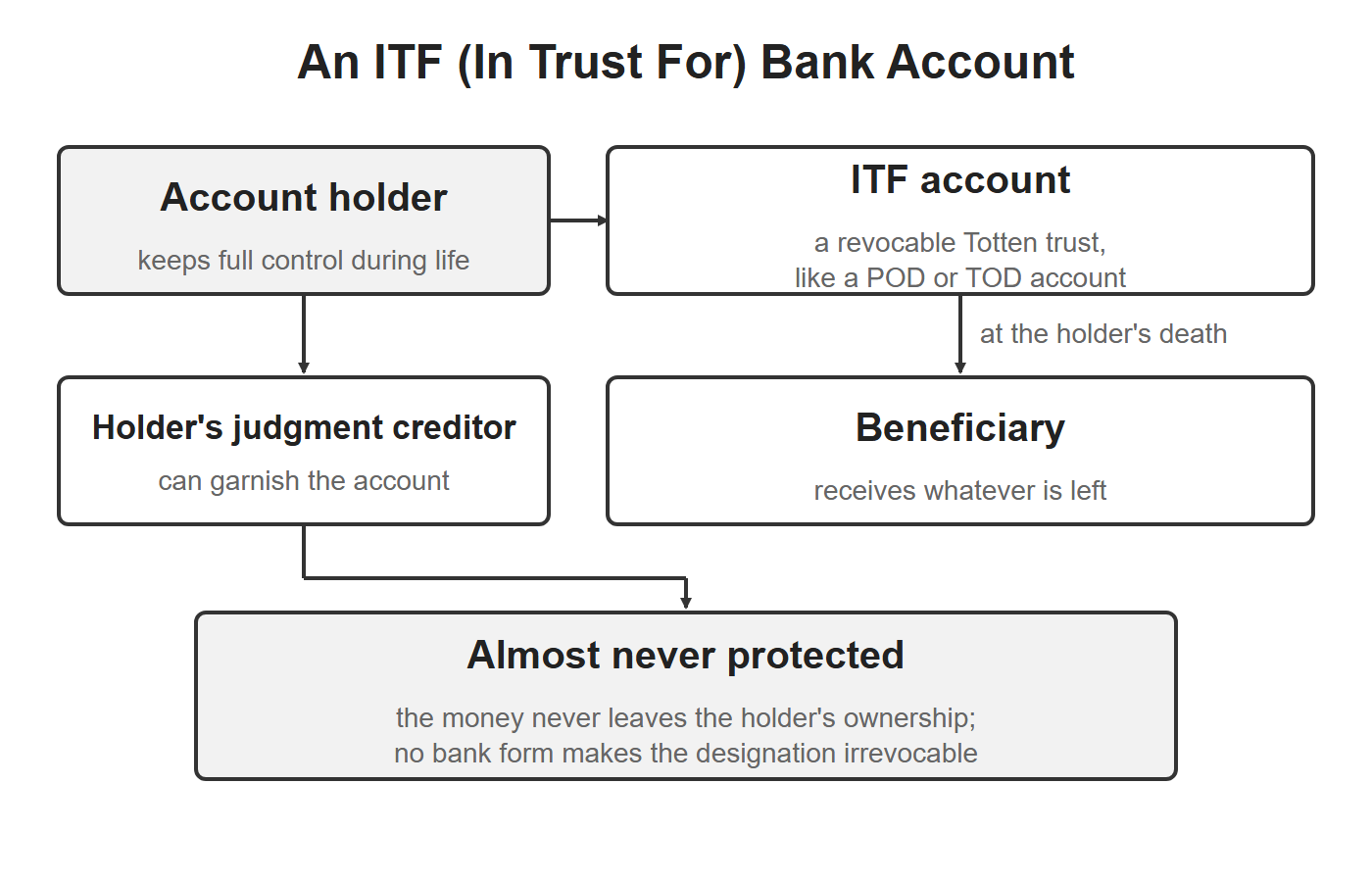
ITF stands for “in trust for.” An ITF bank account names one person as the holder and a second person as the beneficiary, creating what banks call an informal trust. The ITF title almost always gives the holder no protection from creditors. At most banks, an ITF account works like a payable-on-death account. The holder keeps full control, and the beneficiary receives whatever is left when the holder dies.
That arrangement is called a Totten trust. A judgment creditor can garnish it the same way it would garnish any other bank account. An ITF title does not move the money out of the holder’s ownership, and no bank form makes the designation irrevocable.
Speak With an Asset Protection Attorney
Jon Alper and Gideon Alper design and implement Cook Islands trusts for clients nationwide. Consultations are free and confidential.
Request a Consultation
What Does ITF Mean on a Bank Account?
Banks use ITF to designate an account where one person holds funds for another person’s benefit. ATF (as trustee for) is the same arrangement under a different label. The FDIC treats both as informal revocable trusts and insures them for $250,000 per named beneficiary, up to a maximum of five beneficiaries. FBO (for benefit of) usually marks a custodial or agency account. The FDIC insures those by passing coverage through to the underlying owners, each covered separately in their own ownership category.
The designation tells the bank that a beneficiary exists. It does not establish an irrevocable transfer by itself. Most banks allow the account holder to withdraw the full balance, change the beneficiary, or close the account at any time.
Banks describe ITF accounts differently, and some accept language the holder supplies. The account documentation determines the legal character of the arrangement, and a deposit agreement is a thin document to hang a gift on.
How ITF Differs from POD and TOD Accounts
Banks offer ITF alongside two other death-beneficiary designations, POD (payable on death) and TOD (transfer on death). A POD account gives the account holder unrestricted ownership during their lifetime. The beneficiary has no ownership interest while the holder is alive and receives whatever remains at death. A creditor of the account holder can garnish a POD account the same way it would garnish any other bank account.
TOD accounts work the same way. The designation takes effect only at death, and the account holder retains full ownership and control until then. The registration itself does nothing to keep a creditor out. Whether a creditor can reach the balance depends on what the account holds. Retirement assets, annuity and life insurance proceeds, and traceable exempt wages carry exemptions of their own under state and federal law.
ITF accounts follow the same rule. Because the ITF title creates a revocable Totten trust, a judgment creditor can garnish the account just as it can garnish a POD or TOD account. All three designations leave the money in the holder’s ownership until death.
| Feature | ITF (Totten Trust) | POD | TOD |
|---|---|---|---|
| Beneficiary ownership during holder’s life | None | None | None |
| Account holder’s access | Unrestricted | Unrestricted | Unrestricted |
| Creditor protection from holder’s creditors | No | No | No |
| Probate avoidance | Yes | Yes | Yes |
| Revocable | Yes | Yes | Yes |
Why Most ITF Accounts Provide No Creditor Protection
Most ITF accounts are Totten trusts, revocable bank trusts where the account holder deposits money “in trust for” a beneficiary but retains complete control during their lifetime. The beneficiary has no rights until the holder dies.
Because the account holder can withdraw the entire balance at any time, courts treat the funds as the holder’s property. A judgment creditor can reach whatever the debtor can reach. If the debtor can empty the account tomorrow, the creditor can garnish it today.
The Totten trust takes its name from In re Totten, 179 N.Y. 112, 71 N.E. 748 (1904). The New York Court of Appeals held that depositing one’s own money in one’s own name as trustee for another, standing alone, does not establish an irrevocable trust. The deposit creates a tentative trust, revocable at will, until the depositor dies or completes the gift by some unequivocal act while alive.
The court named two acts that would do it: delivering the passbook to the beneficiary, and telling the beneficiary about the account. Courts in other states adopted the rule, Florida’s among them. The Florida Supreme Court applied it in Seymour v. Seymour, 85 So. 2d 726, 727 (Fla. 1956). A Florida appeals court later affirmed the garnishment of in-trust-for certificates of deposit, holding that a Totten trust can be reached by the depositor’s creditors (Kearney v. Unibay Co., 466 So. 2d 271 (Fla. 4th DCA 1985)).
Most people who open ITF accounts assume the “in trust for” language creates some form of protection. It does not.
Why a Bank Cannot Make an ITF Designation Irrevocable
A completed gift moves money beyond the giver’s creditors. What completes it is an act, not a title. Totten named the acts: handing the passbook to the beneficiary, or telling the beneficiary the account exists. A bank’s ITF form does neither, and nothing in a standard deposit agreement obliges the holder to do either.
Once the arrangement acquires terms the deposit agreement does not contain, it is no longer an ITF account. It is an outright transfer, a custodial account under a state transfers-to-minors act, or a written irrevocable trust. Each of those has a document a court can read.
A completed gift also does not put the money beyond a creditor immediately. A creditor whose claim already existed can reach a transfer made for no value while the giver was insolvent, without proving intent. The clock on that claim runs from the transfer date rather than from the lawsuit.
Tax Consequences of ITF Accounts
A gift is complete for federal tax purposes only when the donor gives up the power to take the property back. An account the holder can still draw on is not a completed gift at all. The annual gift tax exclusion ($19,000 per recipient in 2026, adjusted for inflation) reaches only present-interest gifts, even where the transfer is complete. Amounts above the annual exclusion reduce the donor’s lifetime gift and estate tax exemption but do not trigger immediate tax in most cases.
A beneficiary who receives the money at the holder’s death holds a future interest, which the exclusion does not reach. A separate exception covers gifts to minors. It requires that the child be able to use the property before turning 21 and receive it at 21, and an account payable at the holder’s death does neither. A custodial account under a state transfers-to-minors act is a present-interest gift and does qualify.
Transferring income-producing assets to a child can move investment earnings into the child’s lower tax bracket, though a revocable ITF account leaves the earnings taxable to the holder. The kiddie tax rules limit this benefit for any child under 18. They also reach a child who is 18, or a full-time student under 24, but only if the child’s earned income covers half or less of the child’s own support. Unearned income above the kiddie tax threshold is taxed at the parent’s marginal rate regardless of whose name is on the account.
A transfer that leaves the parent’s control also leaves the parent’s taxable estate, which reduces the tax bill only for families near the federal estate tax exemption, $15,000,000 per person in 2026. Retaining control defeats the benefit.
Internal Revenue Code section 2038 pulls back into the estate any transfer the decedent could still alter, amend, revoke or terminate, “in whatever capacity exercisable,” which includes acting as trustee. Section 2036 does the same where the parent kept the right to decide who enjoys the property, or can use the money to meet a support obligation. A parent who stays on the account as the person who controls it has moved nothing out of the estate.
FDIC Insurance Treatment
The FDIC classifies an ITF account as an informal revocable trust, because the category is defined by the absence of a written trust agreement. Each eligible beneficiary receives $250,000 in separate deposit insurance coverage, up to a maximum of $1,250,000 per account holder at a single bank when five or more beneficiaries are named.
That cap comes from the FDIC trust-account rule at 12 C.F.R. § 330.10, which took effect on April 1, 2024 and merged the agency’s former revocable-trust and irrevocable-trust categories into one. Whether an arrangement counts as revocable or irrevocable no longer changes the coverage.
FDIC insurance classification is separate from the creditor protection analysis. An account can qualify for enhanced FDIC coverage while providing zero creditor protection. The FDIC’s label of “trust account” is an insurance category.
Beneficiaries must be natural persons, charities, or other non-profit entities recognized under the Internal Revenue Code, and each must be named in the bank’s deposit account records. Two categories do not count toward coverage: the depositor, and anyone who would take only if a named beneficiary died first.
ITF Accounts vs. Formal Trusts
An ITF designation at a bank is not the same as holding funds inside a formal irrevocable trust.
A formal irrevocable trust has a written trust agreement, an appointed trustee who owes fiduciary duties to the beneficiary, and documented terms governing distributions and management. The trust agreement controls the legal relationship, and courts can examine the document to determine ownership. An ITF account, by contrast, is governed by the bank’s standard deposit agreement plus whatever the account holder intended when the account was opened.
A properly drafted irrevocable trust gives more certainty than an ITF arrangement. The trust agreement states the transfer, defines what the trustee must do, and records that the settlor gave up control. An ITF account relies on inferences from behavior and bank records, and nothing in a bank’s standard form supplies the unequivocal act that completes a gift.
Three Conditions an ITF Account Must Meet
Three things must be true before an ITF arrangement protects money from the holder’s creditors.
- The transfer must be complete. The holder has given the money away through an act or a document, and a bank’s ITF form supplies neither.
- The holder must stop treating the funds as their own: no personal withdrawals, no bill payments, no commingling with personal funds.
- The transfer must survive fraudulent transfer scrutiny.
For most people, outright gifts to family members or a formal trust structure designed for asset protection will be more reliable. An ITF account takes more steps than an outright gift and gives less certainty than a trust.
An ITF designation is less predictable than several alternatives: joint bank accounts titled as tenants by the entirety, dedicated accounts holding exempt funds, and an irrevocable trust created for someone other than the depositor. A trust the depositor creates for their own benefit is not one of them. A creditor of the person who set up the trust can generally reach whatever the trustee could pay back to that person.