

Offshore Trusts

An offshore asset protection trust is an offshore trust formed in a country whose courts refuse to enforce a U.S. judgment against the trust’s assets. A U.S. court cannot compel a foreign trustee to produce records or turn assets over to a creditor. The only path for the creditor is to hire a lawyer in the offshore jurisdiction and relitigate the claim under rules that heavily favor the settlor.
In the Cook Islands, where most U.S. offshore trusts are established, no local court is known to have ordered a trustee to turn trust assets over to a creditor. An offshore trust is the strongest asset protection structure available for people with substantial non-exempt wealth who face or anticipate personal liability.
How Do Offshore Trusts Work?
An offshore trust is governed by the law of the country where it is established. The trustmaker signs a trust deed naming a licensed foreign trust company as trustee and transfers assets into the trust. Assets can move directly into the trust, or into a holding entity the trust owns, typically a Nevis LLC or Cook Islands LLC. Once funded, the trustee holds legal title and manages the assets under the terms of the trust deed.
The trustmaker is usually also the primary beneficiary. The trust deed gives the trustee discretion over distributions, so the trustee decides whether and when to release funds. If the trustmaker could withdraw assets at will, a court could simply order the withdrawal and redirect the funds to a creditor. Because the trustee controls distributions, that order has nothing to reach.
The trustmaker can request distributions, and in ordinary circumstances the trustee honors those requests. But the trustee has no legal obligation to comply. When a lawsuit or creditor threat arises, the trustee’s ability to say “no” keeps assets out of reach.
The trustmaker, trustee, and protector each hold defined powers. Under the trust’s duress clause, the trustee must refuse any instruction a creditor forces the trustmaker to give.
Speak With Our Attorneys
Jon and Gideon Alper set up offshore trusts for clients nationwide. Consultations are free and confidential, by phone or Zoom, and usually available within one business day. You’ll speak directly with Jon or Gideon.
Request a Free Consultation
Typical Structure
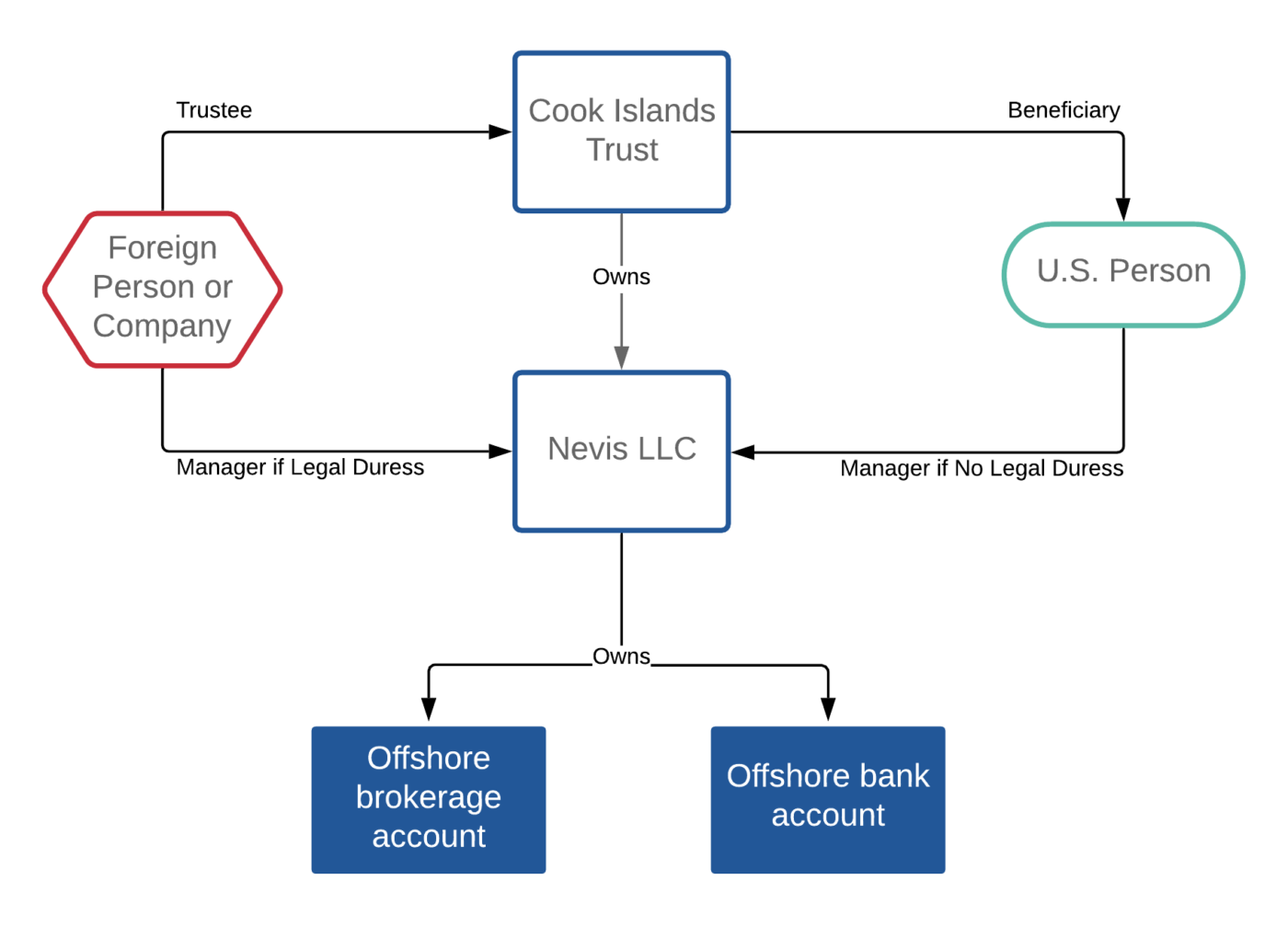
Most offshore trust plans pair a Cook Islands trust with a Nevis LLC or Cook Islands LLC. The trust owns 100% of the LLC. The trustmaker is the LLC’s manager during ordinary times and keeps day-to-day control over the investments and bank accounts it holds.
When a creditor threat arises, the trustee removes the trustmaker as LLC manager and takes direct control, leaving the assets with a trustee a U.S. court cannot compel. Once the threat passes, the trustmaker is restored as manager. The trust deed, LLC operating agreement, and trustee protocols govern exactly how this transition works.
Removing the trustmaker as LLC manager does not require the trustmaker’s consent or a court order. The trustee acts unilaterally under the trust deed.
Advantages of Offshore Trusts
Offshore trusts provide four advantages: creditor protection, financial privacy, estate planning, and jurisdictional diversification.
1. Creditor Protection
The foreign trustee who holds the assets in an offshore trust does not answer to U.S. courts. Under Cook Islands law, a transfer made more than two years after the creditor’s cause of action arose cannot be challenged as fraudulent. A transfer made inside those two years is also protected unless the creditor sued the settlor on the underlying claim, in any court, within one year after the transfer.
Neither rule protects a transfer made after the creditor had already sued the settlor, although the statute does not treat that timing alone as proof of intent to defraud. Any Cook Islands action must be filed within two years of the transfer. The creditor must prove fraud beyond a reasonable doubt. Cook Islands courts give a foreign judgment no effect if its legal basis contradicts the trust statute, or if it decides something Cook Islands law reserves.
Even when a creditor declines to pursue offshore litigation, the trust still makes settlement more likely. Enforcement against a foreign trustee who will not comply with U.S. orders takes years, and a creditor who would spend more on that fight than the claim is worth usually takes a reduced settlement instead.
2. Financial Privacy
Offshore trusts are not listed in any public database. The trust deed is a private document executed in a foreign country. No U.S. public filing reveals who owns a Cook Islands trust or what assets it holds. The IRS knows about the trust through required tax filings, but creditors, business competitors, and the general public do not.
3. Estate Planning
An offshore trust directs how assets pass to beneficiaries at death without probate. The creditor protection continues for the next generation. The trust’s ongoing management, succession, and eventual termination determine how long the protection lasts and how wealth transfers across generations.
4. Jurisdictional Diversification
A person whose entire net worth sits within the U.S. legal system is fully exposed to its courts and political environment. An offshore trust holds a portion of that net worth in a country whose laws favor the asset owner. Capital controls are one of the risks that drive people offshore. The others are bank failures that reach uninsured deposits and a falling dollar.
Disadvantages of Offshore Trusts
The main disadvantages of an offshore trust are bankruptcy vulnerability, loss of direct asset control, and the assets it cannot protect.
1. Bankruptcy Vulnerability
Offshore trusts are weakest in bankruptcy. The bankruptcy estate takes in a debtor’s property wherever in the world it sits. The Bankruptcy Code requires the debtor, not the creditor, to bring assets to the trustee.
Under § 548(e)(1), a bankruptcy trustee can claw back transfers to self-settled trusts made within ten years of filing. The clawback requires the bankruptcy trustee to show that the settlor, in funding the trust, intended to hinder, delay, or defraud creditors. The bankruptcy trustee can avoid the transfer on paper, but a foreign trustee cannot be compelled to send the assets back. Settlors with offshore trusts have filed for bankruptcy voluntarily, and creditors have also filed involuntary petitions against them.
2. Losing Direct Control of the Assets
The trustmaker of an offshore trust must give up direct access to assets transferred into it. When a court orders a trustmaker to repatriate assets, the defense to a possible contempt order is that the trustmaker genuinely cannot comply. That defense only works if the loss of control is real. A court that believes the trustmaker can still reach the assets can order repatriation and jail the trustmaker for contempt until the assets come back.
3. Certain Assets Are Hard to Protect
U.S. real estate held through a trust remains within U.S. court jurisdiction regardless of the trust’s location. A transfer made after a claim has arisen invites a fraudulent transfer challenge. IRS reporting penalties for missed filings can exceed the cost of the trust itself. These offshore trust risks narrow the group of people the structure suits.
Why Do Offshore Trusts Fail?
Offshore trusts fail in court because the settlor kept practical control of the assets, spent trust money personally, funded the trust during or after litigation, or concealed the trust.
Settlors keep control after funding in two ways. A settlor who directs the trustee informally, through written instructions, persistent emails, or demands about specific investments, builds a paper trail showing the structure never changed who decides. When the settlor keeps authorizing LLC payments after the trustee replaces him as manager, the replacement is nominal, and a court that finds it so treats the settlor as still in control. In both patterns, authority moved on paper while the settlor kept it.
The impossibility defense to a contempt order requires the settlor to show, in detail, that he cannot make the trustee comply, and courts set that burden particularly high for an asset protection trust. In FTC v. Affordable Media, the two settlors had made themselves protectors of their Cook Islands trust, with the power to appoint a new trustee. The district court found they still controlled the trust and held them in contempt, and the Ninth Circuit affirmed. A paper trail of directions defeats the defense the same way.
Incomplete funding is a separate failure. A trust protects only what it owns. An LLC interest with no written assignment, or an account never retitled to the trustee, stays the settlor’s property and within a creditor’s reach.
In the cases that reached a court, the sanction fell on the settlor personally, and several settlors went to jail. The foreign trust law held up. Most disputes over a well-built trust settle before a judge writes anything, so the decisions that exist describe mostly the trusts that failed.
Setup Process
Setting up an offshore trust involves five steps:
- Select the jurisdiction. The Cook Islands offers the strongest combination of trustee regulation, favorable statutes, and litigation track record. Nevis costs the same and is the primary alternative. Belize costs less and suits smaller asset levels.
- Choose a licensed trustee company. Licensed Cook Islands and Nevis trustees are regulated by their local governments and subject to minimum capital requirements.
- Complete due diligence. Trust companies run background checks on the trustmaker and beneficiaries, verifying identity, source of funds, and current legal situation. Pending lawsuits must be disclosed. Most trustmakers clear the vetting without difficulty, though the trustee may require the trust deed to address any existing creditor.
- Draft the trust deed and entity documents. The attorney drafts the offshore trust agreement, the operating agreement for any LLC in the structure, and any domestic entity paperwork.
- Fund the trust. Assets move to the offshore LLC or directly to the trustee. Liquid assets transfer most cleanly. U.S. real estate requires a different approach.
Establishing an offshore trust typically takes several weeks from the day the attorney is hired, and funding takes longer depending on the accounts chosen.
When Should an Offshore Trust Be Established?
Under Cook Islands law, a transfer made before the creditor has any cause of action is deemed free of intent to defraud. The usual triggers for setting one up are reaching $500,000 in liquid assets or $1 million in total assets, entering a high-liability profession, buying investment real estate, or signing a personal guarantee.
Cook Islands trusts can be established after a lawsuit has been filed, and they often are. The trust deed includes a Jones clause that authorizes the trustee to pay the existing creditor under defined conditions, reducing fraudulent transfer exposure and providing a contempt defense. Post-claim planning carries higher contempt risk and weaker negotiating leverage than planning done before litigation exists.
U.S. real estate is the main limit on a trust established after a claim, since a U.S. court controls domestic property directly. An offshore trust set up after a lawsuit works best with liquid assets. Funding a trust ahead of a business sale or an expected inheritance, so the proceeds land in the trust before any claim arises, is the strongest of the planning scenarios.
Requirements of Offshore Trusts
Seven conditions determine whether an offshore trust holds up against a U.S. creditor:
- The trust must be irrevocable. A revocable trust offers no creditor protection because the trustmaker retains the power to demand the assets back, which a court can compel.
- The trustmaker cannot act as trustee. A trustmaker who holds trustee power can be ordered to act on the trust’s behalf.
- The trustee should be a licensed foreign trust company, not an individual and not a U.S. entity. Cook Islands law also accepts a registered foreign company or an international company as the qualifying trustee, but licensed trust companies in the Cook Islands and Nevis are regulated and subject to minimum capital requirements.
- The trustee must have discretion to withhold distributions. The duress clause directs the trustee to refuse distributions when the trustmaker is under legal duress from a U.S. creditor.
- The trust protector, if any, must be located outside the United States. A U.S.-based protector is subject to U.S. court jurisdiction and can be compelled to remove or replace the trustee.
- The choice-of-law clause must name the offshore jurisdiction. The trust deed must state that the laws of the Cook Islands or Nevis govern the trust’s validity and administration.
- Assets must move offshore or into an offshore entity controlled by the trustee. Assets physically located in the United States remain subject to U.S. court jurisdiction, whoever holds title.
A licensed offshore trustee holds no beneficial interest in the trust. The trustee’s independence from the trustmaker lets the structure withstand a U.S. court order.
See What a Cook Islands Trust Costs
Our legal fee for a Cook Islands trust is $15,000. Consultations are free and confidential, by phone or Zoom, and you’ll speak directly with the attorney.
See Pricing & Request a Consultation
How Much Does an Offshore Trust Cost?
A Cook Islands offshore trust costs about $21,000 to establish and about $5,000 per year in trustee fees thereafter. Adding the LLC most plans use brings those figures to about $26,000 and about $6,000. Setup fees cover drafting the trust deed, coordinating with the foreign trustee, forming any related entities, and completing the initial regulatory vetting.
| Trust only | Trust + LLC | |
|---|---|---|
| Legal fee (flat) | $15,000 | $20,000 |
| Trustee, first year | ~$6,000 | ~$6,000 |
| Total to establish | ~$21,000 | ~$26,000 |
| Trustee, each later year | ~$5,000 | ~$6,000 |
| CPA tax filings, each year | $2,000–$3,000 | $2,000–$3,000 |
Annual trustee fees cover trust administration. Two costs sit outside them. A CPA charges $2,000 to $3,000 a year for the U.S. tax filings, and the bank or custodian charges its own fees. The attorney structures the trust but does not manage annual compliance.
These costs make offshore trusts impractical for individuals with modest assets or low litigation risk. The minimum net worth at which the economics work is roughly $1 million in total assets or $500,000 in liquid non-exempt wealth.
Are Offshore Trusts Legal?
Offshore trusts are legal. No U.S. law prohibits a citizen or resident from creating a trust in a foreign country, transferring assets to a foreign trustee, or maintaining foreign bank accounts.
The IRS imposes reporting obligations on U.S. persons who create or fund foreign trusts. A properly structured and fully reported offshore trust is entirely lawful. Failing to report does not make the trust unlawful, but each missed filing carries its own penalty.
How Are Offshore Trusts Taxed?
An offshore trust a U.S. person creates for their own benefit is treated as a grantor trust for tax purposes. The IRS looks through the trust entirely. The trust pays no taxes. All income, gains, losses, and deductions flow through to the trustmaker’s personal return, exactly as if the assets were still held directly. An offshore trust changes nothing about what the trustmaker owes the IRS, or when it is owed.
The IRS reporting requirements include Forms 3520 and 3520-A annually, FBAR filings for foreign accounts exceeding $10,000 in aggregate value, and Form 8938 under FATCA. A missed Form 3520 carries a penalty of at least $10,000, and as much as 35% of the value transferred. A missed Form 3520-A carries a penalty of at least $10,000, and as much as 5% of the trust assets the U.S. person is treated as owning. A CPA handles all offshore trust tax filing and reporting.
Which Countries Are Best for Offshore Trusts?
The Cook Islands is the strongest offshore trust jurisdiction. Its trust law has the longest track record in asset protection trust litigation, and no Cook Islands court is known to have ordered a trustee to turn assets over to a creditor. A creditor must prove fraud beyond a reasonable doubt, file in the Cook Islands within two years of the transfer, and start the case over because Cook Islands courts do not recognize foreign judgments.
Nevis offers a viable alternative at the same cost. Nevis law requires creditors to post a bond of EC$270,000, about US$100,000, before initiating litigation. The courts there will not enforce a foreign judgment against the trust or its assets. Nevis bars a challenge to a transfer made more than one year after the claim arose. Any challenge must be filed in the Nevis court within two years of the transfer. The comparison between Cook Islands and Nevis trusts turns on the Cook Islands’ deeper litigation track record against the Nevis creditor bond.
The best offshore trust countries differ in their burden-of-proof standards, limitation periods, and enforcement histories. For most U.S. residents seeking creditor protection, the Cook Islands remains the first choice.
Who Should Consider an Offshore Trust?
Offshore trusts are appropriate for people whose litigation exposure and asset level justify the cost. The people who benefit most face above-average creditor risk from their profession or business activities and have exhausted the domestic planning alternatives available in their state. Most states have no domestic asset protection trust statute, and state law differs widely in how much home equity and jointly owned property a creditor can reach. Among offshore asset protection structures, an offshore trust is the strongest, because a foreign trustee holds title to the assets and decides whether they are distributed.
Private placement life insurance is marketed to the same audience. PPLI shelters investment gains from income tax, while an offshore trust blocks creditor collection. The two structures are sometimes combined.
Physicians, business owners, contractors, real estate investors, and other high-risk professionals each face distinct liability patterns that shape how the trust is structured and funded. Whether planning is proactive, triggered by a filed lawsuit, or timed around a liquidity event determines which provisions the trust deed needs.
Americans living abroad already hold foreign accounts and file FBAR and FATCA disclosures, so the reporting an offshore trust requires is a smaller change for an expat than for someone who has never banked outside the United States. The unlimited marital deduction, which otherwise lets a spouse inherit any amount free of federal estate tax, does not apply when the surviving spouse is not a U.S. citizen. A qualified domestic trust defers that estate tax while the offshore trust protects against creditors.
In divorce, an offshore trust can limit a spouse’s ability to enforce property division and support orders against trust assets, though family courts have broader equitable powers than most creditors. The trustee can take control of cryptocurrency more easily than most other assets. Stock portfolios, business interests, and intellectual property each fund the trust in a different way.
Offshore Trust vs. Domestic Trust
Several U.S. states, including Nevada, South Dakota, Alaska, and Delaware, allow self-settled asset protection trusts that, on paper, compete with offshore trusts. Domestic asset protection trusts cost less, carry no foreign reporting obligations, and use a trustee located in the United States.
However, domestic asset protection trusts can only reliably protect people who live in a state that has enacted a DAPT statute. A creditor can sue in the debtor’s home state, and if that state has no DAPT law, the court will likely apply local law rather than the DAPT state’s law, rendering the trust useless. For residents of non-DAPT states, which is the majority of the country, a domestic trust is not a reliable strategy.
Even for DAPT-state residents, domestic trusts have two additional vulnerabilities. Federal bankruptcy jurisdiction under § 548(e)(1) imposes a ten-year lookback on transfers into a self-settled trust. A U.S. bankruptcy trustee who proves the settlor’s actual intent to hinder, delay, or defraud can compel a domestic trustee to comply, while a Cook Islands trustee cannot be compelled by a U.S. court. Most DAPT statutes also have limited or no appellate case law confirming they work as intended, while Cook Islands trust law has been tested in U.S. litigation for more than 30 years.
An offshore trust avoids these problems because the trustee operates in a country that refuses to recognize U.S. court orders. A judge in Nevada, Wyoming, or any other DAPT state still has power over a trustee who sits in that state, which is what separates an offshore trust from a domestic one.
Bridge Trust Alternative
A bridge trust is a domestic trust that can migrate to an offshore jurisdiction when triggered by specific events, typically the filing of a lawsuit or the entry of a judgment. A bridge trust reduces upfront costs and avoids foreign trust reporting until the migration happens, which suits people who want offshore protection but are not ready to commit to it.
The tradeoff is that the protection is not yet activated. If a creditor moves faster than the migration can execute, the assets may still be within reach. The trustee is also still in the United States, so a court can forbid the move. A migration that happens after a claim arises can be set aside as a fraudulent transfer.
Hungarian Trusts
Hungary enacted trust legislation in 2014 that allows foreign individuals, including U.S. citizens, to create trusts under Hungarian law. A U.S. judgment has no direct force in Hungary, which recognizes foreign money judgments in property matters only on a reciprocity basis. A creditor must sue in Hungary and show that the recipient acted in bad faith or took the assets without paying for them. The Hungarian trust has attracted interest from European individuals and some U.S. planners seeking an EU-based alternative.
The Hungarian trust offers advantages in EU regulatory recognition and access to tax treaties, but it lacks the decades-long litigation track record that the Cook Islands and Nevis have built. A U.S. resident whose main goal is creditor protection gets more from a Cook Islands trust than from a Hungarian one.
Offshore Trust Financial Accounts
An offshore trust holds assets through foreign bank or brokerage accounts at institutions without U.S. branches. A U.S. court cannot compel a foreign bank that has no U.S. presence to freeze or hand over an account. Because the trustee is the account holder and signatory, the trustmaker has no independent account access.
Opening foreign bank accounts as an individual U.S. citizen has become increasingly difficult. Most reputable foreign banks no longer accept individual U.S. applicants because of FATCA compliance costs. The trust or its offshore LLC opens the account instead, and the trustee maintains the banking relationship. Offshore bank accounts held within the trust structure have to be at an institution that is willing to work with Cook Islands or Nevis entities and is set up for U.S. reporting.
Is an Offshore Trust Worth It?
An offshore trust earns its cost when the exposure is larger than the roughly $21,000 to establish the trust and $5,000 a year to keep it, and when enough of the wealth is liquid to move offshore. For a physician, contractor, or business owner holding $1 million in total assets or $500,000 in non-exempt liquidity, that test is usually met. Below it, a Belize trust or domestic planning fits better.
Two things limit that answer. In bankruptcy the trust faces a trustee with a ten-year lookback and worldwide reach over the debtor. The case then turns on the trustmaker’s own conduct, since the bankruptcy trustee has to prove the trustmaker’s actual intent to hinder, delay, or defraud. The protection also depends on a genuine loss of control. A trustmaker who keeps a practical route back to the assets gives a court someone to order and a reason to hold him in contempt.
FAQs
What are the disadvantages of an offshore trust? An offshore trust is weakest in bankruptcy, requires the settlor to give up direct control of the assets, and cannot protect every asset. A bankruptcy trustee can avoid the transfer if the settlor meant, in funding the trust, to hinder, delay, or defraud creditors. U.S. real estate, in particular, stays within a U.S. court’s reach wherever the trust sits.
What is a major disadvantage of an asset protection trust? A major disadvantage of an asset protection trust is that the settlor gives up direct control of the assets. With an offshore trust the loss of control must be real, because a court that believes the settlor can still reach the assets can order them repatriated and jail the settlor for contempt until they return.
How much does it cost to set up an offshore trust? A Cook Islands trust comes to about $21,000 all told, or about $26,000 with an offshore LLC. That total is the attorney’s flat fee of $15,000 or $20,000 plus the trustee’s first-year charges of about $6,000. Each later year the trustee charges roughly $5,000 (about $6,000 if there is an LLC), and the CPA’s annual U.S. tax filings add $2,000 to $3,000.
Do offshore trusts pay taxes? No. An offshore trust a U.S. person sets up for their own benefit is a grantor trust, so the IRS taxes the trust’s income to the settlor as though the settlor still held the assets directly. The trust itself owes no U.S. income tax and saves the settlor none, but it adds annual IRS reporting, including Forms 3520 and 3520-A, which the settlor’s CPA prepares.
Are offshore trusts legal? Yes. A U.S. citizen or resident may lawfully create a trust in another country, transfer assets to a foreign trustee, and keep accounts abroad. The IRS requires the trust to be reported every year. Missing a report brings penalties, though the trust itself stays lawful.
Can a U.S. citizen have an offshore trust? Yes, a U.S. citizen can set up an offshore trust by signing a deed that names a licensed trust company abroad as trustee, then funding the trust. The trust must be irrevocable, the settlor cannot act as trustee, and the assets must sit offshore or in an offshore entity the trustee controls. The cost makes sense at roughly $1 million of total assets or $500,000 of liquid, non-exempt assets.
Alper Law has structured offshore and domestic asset protection plans since 1991. Schedule a consultation or call (407) 444-0404.
