

Kelley’s Homestead Paradigm

Kelley’s Homestead Paradigm is a decision-tree flowchart created by Florida attorney Rohan Kelley and first published in the March 1991 issue of the Florida Bar Journal. A series of yes-or-no questions determines who inherits a Florida homestead property at the owner’s death, whether the owner could have devised it by will, and whether the constitutional creditor protection survives the transfer.
Article X, Section 4(b) says homestead exemptions “shall inure to the surviving spouse or heirs of the owner.” The creditor shield does not automatically expire at death, but whether it carries forward depends on the descent path the property follows. The paradigm identifies exactly where asset protection continues and where it falls away.
How the Paradigm Works
Kelley’s Paradigm asks six numbered questions, beginning with whether the property was the decedent’s homestead at death. Each level corresponds to a specific constitutional or statutory provision. Each branching point leads the property either toward continued protection or into probate, where it becomes a general asset available to creditors.
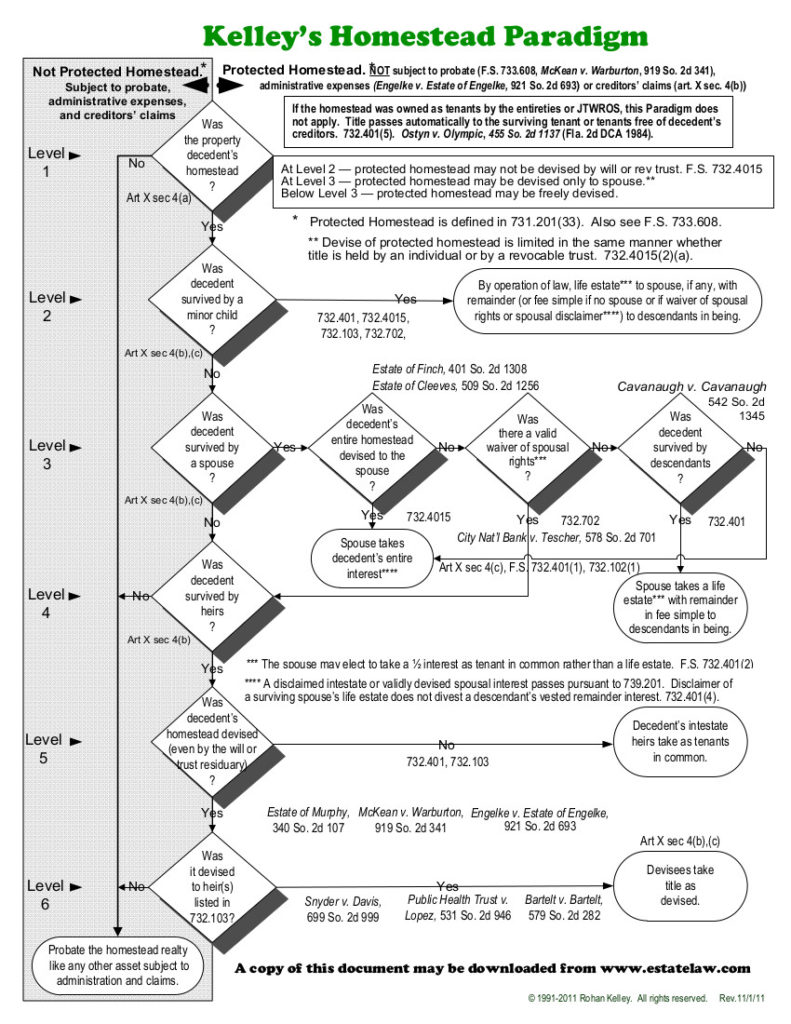
Level 1: Was the Property the Decedent’s Homestead?
The property must have qualified as the decedent’s protected homestead at death. Three constitutional elements had to be satisfied. The property had to be owned by a natural person. The owner or the owner’s family had to live in it as their home. The property must also have fallen within the size and contiguity limits set out in Article X, Section 4(a).
If the property was not protected homestead at death, the analysis stops. The property enters the probate estate as a general asset, available to pay the decedent’s debts. This can happen when the owner had abandoned the property, or when the property was titled in an entity that cannot hold homestead, such as an LLC.
Acreage works differently. Land beyond the constitutional limit does not destroy the homestead. Article X, Section 4(a) grants the exemption to the extent of one-half acre inside a municipality and 160 acres outside one. A property over the limit keeps its exemption on the corresponding share of value, and only the excess remains reachable.
Speak With Our Attorneys
Alper Law has helped clients protect their assets since 1991. Consultations are confidential, by phone or Zoom, and usually available within one business day.
Book a Consultation
Ownership is the element a lifetime transfer defeats. If the decedent held no legal or equitable interest in the property at death, it cannot have been the decedent’s homestead, and the analysis ends. A person who deeded the property to a child, then stayed on as a guest, has no ownership interest to protect.
The level also addresses properties held in trusts. A revocable living trust preserves homestead status. Section 732.4015(2) treats the grantor of a revocable trust as the homestead’s owner and treats the trust’s disposition as a devise. The property therefore stays inside the analysis exactly as it would if the grantor held title. An irrevocable trust raises a harder question: whether the beneficiary’s interest constitutes “ownership” for homestead purposes.
Level 2: Was the Decedent Survived by a Minor Child?
Article X, Section 4(c) of the Florida Constitution bars any devise of homestead when the owner is survived by a minor child. When a minor child survives, the homestead cannot be devised to anyone, not to the spouse, not to an adult child, not to a trust. Section 732.4015(2)(b) closes the obvious workaround by treating a disposition through the grantor’s revocable trust as a devise, so a will and a revocable trust fail alike.
Three arrangements fall outside the bar because they are not devises. Entireties property and joint tenancy with right of survivorship pass automatically to the surviving co-owner; Section 732.401(5) excludes both from the descent statute. An irrevocable lifetime transfer is also not a devise. Under Section 732.4017, the transferred interest does not descend under Section 732.401 at all.
Spouse and minor children survive. The homestead descends by operation of law under Section 732.401 of the Florida Probate Code. The surviving spouse receives a life estate, and the descendants in being at the decedent’s death receive a vested remainder, per stirpes. Per stirpes means the decedent’s children take equal shares, and a child who died before the decedent is represented by that child’s own descendants. The spouse has the right to live in the home for life. The remainder holders own the property subject to that right.
The surviving spouse may elect to take an undivided one-half interest as tenant in common instead of the life estate. The spouse makes the election by recording a notice of election in the county’s official records. It must be made within six months of the owner’s death and during the surviving spouse’s lifetime. Once made, it is irrevocable. The tenant-in-common election under Section 732.401(2) gives the spouse a present ownership stake rather than a mere right of occupancy. The remaining one-half vests in the descendants per stirpes.
An attorney in fact or a guardian of the property of the surviving spouse may make the election with court approval. Before approving it, the court must determine that the election is in the spouse’s best interests. A petition filed within the six months extends the deadline to at least 30 days after the court rules.
Neither the spouse nor the descendants can force a sale of the home. A life tenant and a remainderman are not co-owners of the same estate, so no partition action lies between them, and the remaindermen cannot partition even among themselves while the life estate lasts. The one-half tenancy in common is different. It makes the spouse a present co-owner with the descendants, and a co-owner can bring a partition action.
Minor children but no spouse. The homestead passes directly to the decedent’s descendants per stirpes. A minor can own the property but cannot sell or mortgage it, so a guardianship of the property has to be opened before the home can be sold or refinanced, and it runs until that child turns eighteen.
In both scenarios, creditor protection continues. The property passes outside probate and is not available to satisfy the decedent’s debts.
Level 3: Is There a Surviving Spouse?
If no minor children survive, the homestead may be devised, but only to the surviving spouse, and only in fee simple. Article X, Section 4(c) permits that devise as an exception, and Section 732.4015(1) repeats it. The Florida Supreme Court held in In re Estate of Finch (1981) that the exception is exclusive. A will leaving the spouse only a life estate is not a permitted devise. A devise of a partial interest, or a devise that bypasses the spouse, fails for the same reason.
If the decedent’s will makes a valid devise to the spouse in fee simple, the spouse takes the property outright. Creditor protection transfers with it.
If the will attempts an invalid devise (anything other than fee simple to the spouse), the devise is void and the property passes by intestate succession. When there are also surviving descendants, the spouse takes a life estate (or may elect the one-half tenant-in-common interest) and the descendants take the vested remainder. When there are no descendants, the spouse inherits the property in fee simple under Section 732.102.
Spousal waiver. A spouse can waive the homestead devise rights before the owner’s death. Section 732.702 allows the waiver by written contract or agreement, signed before two subscribing witnesses, before or after the marriage. A waiver signed after the marriage also requires each spouse to make fair disclosure of his or her estate; one signed before the marriage does not.
Section 732.7025 allows the waiver in a deed that contains the statutory waiver sentence. The deed language releases the devise restriction but not the requirement that the spouse join in a mortgage, sale, or gift during the owner’s lifetime. If the waiver is valid and no minor children survive, the constitutional restriction on devise falls away and the homestead may be devised freely.
A waiver of the devise restriction is not a waiver of the creditor protection. Section 732.7025(2) says so for the deed waiver. Its language cannot be read as releasing the protection against the owner’s creditors. The waiver changes who may receive the home, and that choice decides whether the protection carries forward. A devise to someone inside the intestate class keeps it, and a devise outside that class does not.
No spouse, no minor children. The constitutional restriction on devise does not apply, and the owner may devise the homestead to anyone.
Level 4: Does the Decedent Have Any Heirs?
When neither a spouse nor a minor child survives, whether the homestead keeps its protection turns on whether the decedent left any heirs at law. Heirs at law are the relatives who would inherit under Florida’s intestacy statutes.
If the decedent has no heirs at law, the homestead loses its protected status. The property becomes a probate asset, subject to creditor claims and the expenses of estate administration. Under Section 732.107, property with no taker escheats to the state.
If heirs exist, the protection remains intact.
Level 5: Was the Homestead Devised?
A homestead that was not devised descends by intestate succession to the decedent’s heirs at law, per stirpes. The heirs, defined in Section 732.103, take the property as tenants in common, and the creditor protection passes with it. When the decedent left a will or trust that did devise the homestead, one question remains: whether the devisee is within the class of heirs at law.
Level 6: Was the Property Devised to an Heir at Law?
A devise to an heir at law keeps the creditor protection; a devise to anyone outside that class loses it. In Snyder v. Davis (1997), the Florida Supreme Court held that an owner with no surviving spouse or minor child may devise the homestead to any family member within the Section 732.103 class. The creditor protection after death passes with the devise. The class is broader than the actual line of inheritance. A grandchild takes the protection even though a living child ranks ahead in the intestacy order.
Devise to an heir at law. If the devisee is within that class, the creditor protection continues and the devisee takes the property free of the decedent’s creditor claims. The will controls which member of the class receives the property; the constitution and Snyder require only that the recipient be inside it.
Devise to a non-heir. If the devisee is someone outside the class of intestate heirs, the creditor protection is lost. The property becomes a general asset of the probate estate, available to satisfy the decedent’s debts and the costs of administration. The First District Court of Appeal addressed this scenario in Webb v. Blue (2018), where the decedent left his homestead to a friend. Because the friend was not an heir at law, the court held that the property entered the probate estate.
The Blended Family Problem
A married homeowner with adult children from a prior marriage cannot leave the home to those children by will. The Constitution prohibits any devise other than fee simple to the spouse when a spouse survives. An owner who dies without planning around the restriction leaves the spouse a life estate and the children the vested remainder, a shared ownership structure that neither side may want.
The spousal waiver is the primary planning tool here. If the spouse executes a valid waiver of homestead devise rights, the owner can devise the property to the adult children. The children qualify as heirs at law, so the creditor protection survives under Level 6 of the paradigm.
Without the waiver, the spouse’s life estate vests automatically at death. A post-death disclaimer by the spouse cannot cure an invalid devise. Because the remainder vested in the descendants at the moment of death, a later spousal action cannot strip it away. Under Section 732.401(4), a surviving spouse who disclaims the life estate under Chapter 739 cannot divest the descendants’ interests.
Tenants by the Entirety as a Planning Override
Tenants by the entirety ownership between spouses bypasses the paradigm at the first death. The surviving spouse becomes the sole owner by operation of law. Under Section 732.401(5), the descent statute does not reach entireties property or joint tenancy with right of survivorship. Nothing is devised, so the constitutional restriction on devise never applies and no level of the flowchart runs.
The override lasts one death. When the surviving spouse later dies owning the home alone, the full analysis applies to that spouse’s estate, so entireties ownership protects the survivor rather than controlling where the property goes afterward. It works when the goal is to leave the property outright to the surviving spouse. It does not work when the goal is to leave the property to someone else, because a will cannot override survivorship.
Sale Proceeds After Death
Heirs who sell homestead property after the owner’s death do not lose the creditor protection attached to it. The Second District Court of Appeal confirmed this in In re Estate of Hamel (2002). Because the heirs’ homestead rights vested at death, the sale proceeds remained protected even after the property was sold.
One drafting choice reverses that result. When the will directs the personal representative to sell the homestead and add the proceeds to the estate, the property loses its homestead character and the proceeds are exposed. That is the rule of Estate of Price (1987) and Knadle v. Estate of Knadle (1996), the one exception Hamel recognizes. An owner who wants the protection to survive should leave the homestead to the heirs in kind. Heirs who inherit the property itself are not held to the reinvestment rules that govern an owner’s lifetime sale.
Planning With the Paradigm
Four lifetime choices control where the homestead goes and whether the creditor protection follows:
- Spouse inherits outright. A devise in fee simple (permitted when no minor children survive) or entireties titling passes the home to the spouse with the protection intact.
- Children from a prior marriage inherit. A valid spousal waiver signed before death lets the owner devise the homestead to the children, who keep the protection as heirs at law.
- An unmarried owner’s devisee inherits. The protection survives when the devise goes to someone within the Section 732.103 class of heirs.
- A friend, a charity, or another non-heir inherits. The devise is valid when no spouse or minor child survives, but the creditor protection is lost when the property enters the probate estate.
Protection follows the home when it passes to the surviving spouse or to someone in the heir class. A devise outside that class sends the homestead into probate, where creditors can reach it.
Alper Law has structured offshore and domestic asset protection plans since 1991. Schedule a consultation or call (407) 444-0404.
