Florida Residency

A Florida resident is someone who lives in Florida and intends to make it their permanent home. To become a Florida resident you must establish presence and intent. There is no minimum number of days, no waiting period, and no single form that creates residency.
You can prove intent with records: a Florida driver’s license within 30 days, vehicle and voter registrations, and a recorded Declaration of Domicile if you want dated evidence. The remaining work is severing the ties your former state uses to keep you on its tax rolls.
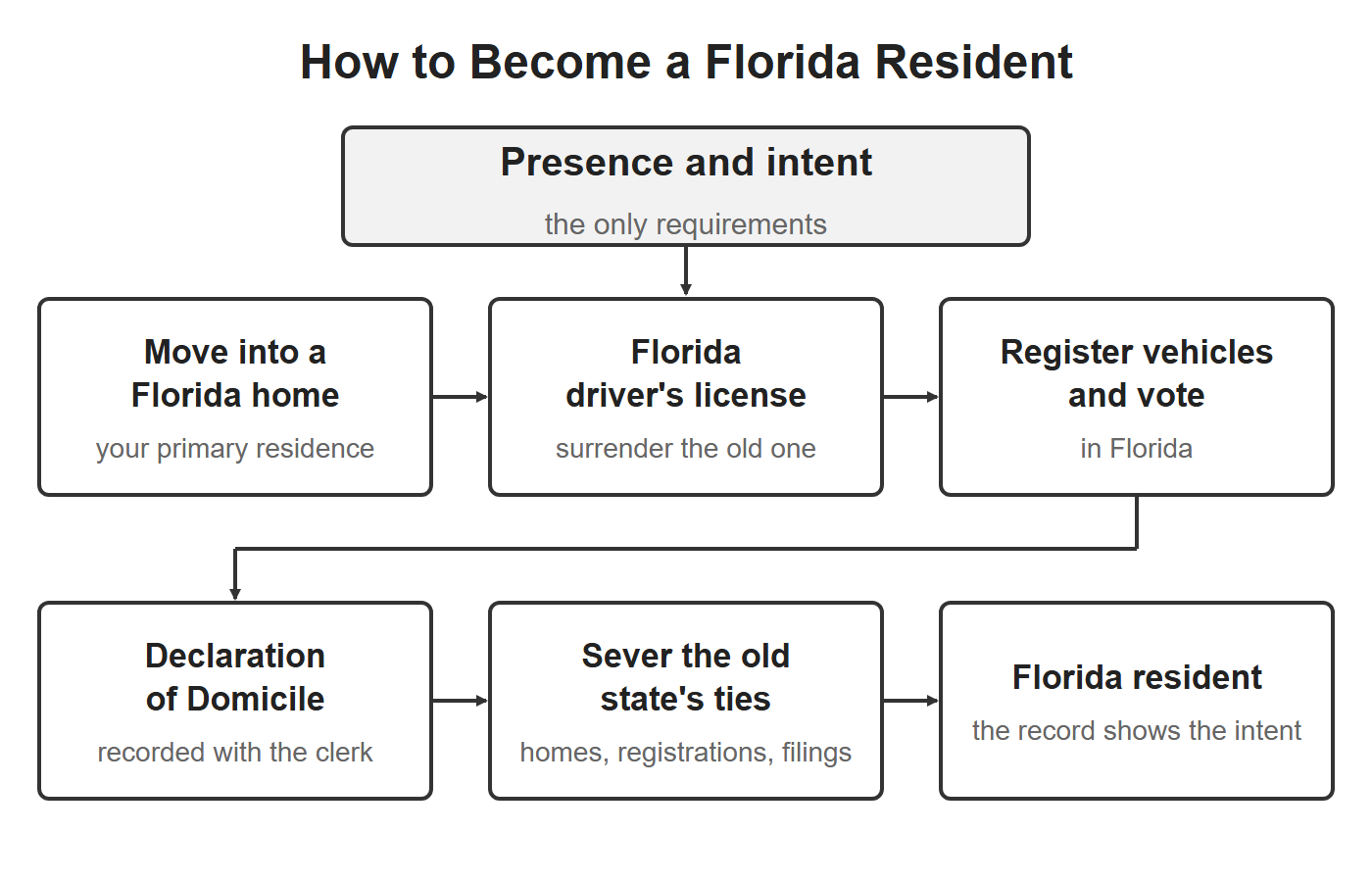
Requirements to Become a Florida Resident
To become a Florida resident, move into a Florida home and make it your primary residence, and then build the record showing you intend to stay. Florida sets no minimum day count; the 183-day threshold comes from your former state, which uses it to decide whether you still owe its income tax.
Here are the nine most important steps to establishing Florida residency:
- Move into a Florida home. Buy, lease, or move into the Florida home where you will actually live. It should be where you sleep, receive mail, and keep personal belongings.
- Get a Florida driver’s license. Florida law requires a Florida license within 30 days of establishing residency. Surrender your prior state’s license at the same time.
- Register your vehicles in Florida. Title and register every car, motorcycle, boat, and RV within 10 days of establishing residency, and obtain Florida insurance from a Florida-licensed agent.
- Register to vote in Florida. You can register at the DMV when you get your license, or online with your county supervisor of elections. Cancel your registration in your prior state.
- File a Declaration of Domicile. Record a sworn statement with the clerk of the circuit court in your Florida county stating that Florida is your permanent home. Filing is optional, but the recorded declaration is dated proof of the move.
- File for homestead exemption. If you own a Florida home and occupy it as your primary residence as of January 1, file with the county property appraiser by March 1 of that tax year.
- File a final resident tax return in your former state. File a part-year or final resident return for the year of the move, and switch to nonresident returns only if income still comes from that state. The final return is the dated record of when the former residency ended.
- Move your financial and legal records to Florida. Change addresses on bank accounts, brokerage accounts, credit cards, insurance policies, IRS records, Social Security, professional licenses, and estate planning documents.
- Sever ties to the former state. Cancel the prior state’s voter registration, vehicle registration, homestead or principal-residence tax exemption, and any state-resident benefits. Keep time there under 183 days a year, and spend more days in Florida than in any other state.
Speak With Our Attorneys
Alper Law has helped clients protect their assets since 1991. Consultations are confidential, by phone or Zoom, and usually available within one business day.
Book a Consultation
Residency is the foundation of Florida asset protection. The homestead exemption, wage exemptions, and tenancy by the entireties protection all require Florida residency. Moving to Florida for asset protection still works when the move follows a claim.
How Long Do You Have to Live in Florida to Be a Resident?
There is no minimum time you must live in Florida to be a Florida resident. Residency begins the day you make Florida your permanent home with the intent to remain. The main benefits of Florida residency start the same day: no state income tax, no estate or inheritance tax, and Florida’s creditor exemptions.
The waiting periods that do exist belong to particular programs. In-state tuition at a Florida public university requires 12 consecutive months of Florida domicile before the first day of classes. Federal bankruptcy law lets a debtor claim Florida’s exemptions only after 730 days of Florida domicile before the filing date. That wait applies only in bankruptcy; a creditor collecting a judgment in state court cannot rely on it.
Florida’s driver-license and vehicle-registration statutes define a resident as someone domiciled in Florida for more than six consecutive months, or who has registered to vote, filed a Declaration of Domicile, or claimed the homestead exemption. That definition governs licensing and registration only. Beyond licensing, what people call Florida’s six-month rule for residency is the former state’s 183-day income-tax test under another name; no Florida statute makes six months a general residency requirement.
The 183-Day Rule
The 183-day rule is a day-counting test that high-tax states use to keep taxing people who claim to have moved to Florida. Florida itself has no 183-day requirement and no day count of any kind. Florida has no state income tax, so it has no reason to count your days.
For anyone keeping a home in a high-tax state, that state’s threshold is the one that applies. New York and New Jersey treat a person as a statutory resident, taxable on all income regardless of a Florida domicile, when that person keeps a permanent place of abode there and spends more than 183 days in-state. California has no statutory-residency test; it weighs a person’s overall contacts with the state and presumes residency for anyone there more than nine months of the year.
Days are counted generously, so any part of a day spent in the state counts. New York excludes only two kinds of day: one spent there solely to board a flight, ship, train, or bus bound for a point outside the state, and one spent confined in a New York medical institution. The practical target is fewer than 183 days in the former state, with the days documented as they happen through a calendar, credit-card and phone records, and travel itineraries rather than reconstructed after an audit notice arrives.
Most of the residency confusion we see comes from one mismatch: Florida sets no day count to satisfy, but the state you left still applies its own. People who move to Florida tend to chase a Florida threshold that does not exist, while ignoring the New York or California test that still applies to them as departing residents. The result is a Florida domicile that is solid on paper and an unchanged calendar that the former state uses to keep them on the tax rolls anyway.
Florida Residency Requirements for Tax Purposes
Florida imposes no income tax and no tax-residency test of its own, so the residency requirements for tax purposes run in one direction: proving to the state you left that your domicile changed. A former state can keep taxing a person as a resident until the record shows Florida became the permanent home and the old ties were cut. Cutting the old ties means a final resident return in the former state, cancelled registrations there, and a former home that has been sold or is kept only as a vacation property.
The date of a liquidity event decides which state taxes it. A stock sale or business-interest sale recognized after the Florida move escapes the former state’s resident income tax; the same sale closed a few months earlier is taxed by the former state. Income tied to property or operations in the former state stays taxable there regardless of the move.
Domicile also decides which state can tax an estate at death. Florida has no estate or inheritance tax. Departure-state audits usually cover the first one to three tax years after the move. Establishing Florida residency for tax purposes depends on the records built in year one.
Fastest Way to Become a Florida Resident
The fastest way to become a Florida resident is to move into a Florida home and complete four steps during the first week: the driver’s license, vehicle registration, voter registration, and the Declaration of Domicile. Residency itself begins the day you occupy the home intending to stay. The records exist to date-stamp that day.
One DMV appointment can produce three of the four records, because Florida lets you register to vote and transfer vehicle titles during the license visit. The Declaration of Domicile takes a separate stop at the clerk of court. It is the fastest dated evidence available because the clerk records the sworn statement the same day you file it. Filing fees are typically under $25.
How to File a Florida Declaration of Domicile
A Florida Declaration of Domicile is a sworn statement, recorded with the clerk of the circuit court in your county, declaring that Florida is your permanent home. Florida law authorizes the filing, and the clerk records it the day it is presented. Recording a one-page declaration costs $10, the statutory clerk’s fee; a certified copy, the clerk’s oath, or an outside notary adds a few dollars.
The statute behind the filing, section 222.17, requires the statement to list your Florida address, your former out-of-state residence, and any other homes you still keep. Sign it under oath before a notary or a deputy clerk. Most county clerks publish a fillable form. Several accept filings by mail, although mailed filings in the larger counties can take a few weeks to come back recorded. Filing in person gets the stamped copy the same day.
The declaration comes in two versions. The standard form covers a person whose only home is in Florida; a second version, written for people who keep homes in more than one state, declares the Florida home the predominant and principal one.
Filing either version is voluntary (no Florida statute requires it), but the recorded declaration is the cheapest dated evidence of intent available. Auditors and courts weigh the recording date along with the rest of the record; residency itself dates from the day you occupied the Florida home intending to stay, whether or not a declaration was ever filed.
Florida Declaration of Domicile Form
Florida law sets out what a Declaration of Domicile must contain, but it does not print the form itself. The statute, section 222.17, directs the Department of Legal Affairs to prescribe a form for the clerks, and most county clerks publish their own version. A clerk’s version works the same as our downloadable sample. Both include the statutory contents. A form published by one county’s clerk can be used in another.
Florida law directs the filing to the clerk of the circuit court for the county where the declarant resides. The county to use is the one in the declarant’s address. The form’s optional paragraph belongs in the statement only when the declarant keeps a home outside Florida; it declares the Florida home the predominant and principal one, the statute’s wording for a person with more than one residence.
The notary block at the end has the physical-presence and online-notarization checkboxes that appear on current Florida notary certificates; the clerk records the statement either way.
Download this form: Word (.docx) | PDF · Part of our asset protection forms library.
Can You Be a Resident of Two States?
Yes. A person can be a resident of two states at once, but only one of them can be that person’s domicile. Each state, and each program within a state, applies its own residency test, so a person domiciled in Florida can be taxed as a New York statutory resident in the same year. That overlap produces dual-taxation disputes.
Florida courts define domicile as the place where a person fixes a home with the present intention of keeping it permanently. Once a Florida domicile is established, it continues until a new one replaces it. Florida law presumes the prior domicile continues, so the person claiming the domicile changed carries the burden of proving it.
Intent alone does not create domicile. A recorded Declaration of Domicile states the intention, but it does not establish domicile for someone who is not actually living in Florida. Domicile requires both the intention to make Florida home and the overt act of residence behind it. A person who files every Florida form but keeps daily life in the former state holds a domicile claim that an auditor or court can defeat.
Domicile decides the financial questions: which state taxes your income, which state can tax your estate, where your will is probated, and whether you can claim Florida’s homestead protection. Residency is settled benefit by benefit, with in-state tuition, voting, and hunting licenses each applying its own test.
How Do Snowbirds Establish Florida Residency?
Snowbirds can establish Florida residency without spending the entire year in Florida. Florida does not require year-round occupancy. The state where the snowbird spends the rest of the year decides whether to keep taxing the snowbird as a resident, using its own domicile and day-count tests.
A snowbird’s Florida home should be the predominant one: more days in Florida than in any other single state, with the Florida property as the actual base for mail, personal belongings, and daily life. Every record an auditor can pull should point to Florida, including the driver’s license, voter registration, vehicle registration, federal tax return address, professional licenses, bank statements, and credit card billing addresses. The same goes for doctors’ offices, country clubs, and religious organizations.
Florida provides a Declaration of Domicile for people with homes in more than one state. The statement affirms that the Florida home is the “predominant and principal home” and that the person intends to keep it permanently. The recorded declaration is dated, sworn evidence of intent that auditors weigh with the rest of the record.
A declaration does not survive an audit when the doctors, club memberships, and billing addresses stay in the former state, where the snowbird also keeps the larger home and spends more than 183 days a year. The auditor points to those unchanged records, which the sworn statement does not defeat.
Can You Become a Florida Resident Without Living in Florida?
No. Someone living in another state cannot become a Florida resident by renting a mailbox, buying an investment condo, or mailing the clerk a Declaration of Domicile. Domicile requires the act of residence. An auditor or court defeats a paper-only claim by pointing at where daily life actually happened.
The rule works differently for people who live nowhere in particular. Full-time RV travelers, cruisers, and Americans working abroad can establish Florida domicile by actually living in Florida first, then keep it while traveling indefinitely, because an established domicile continues until a new permanent home replaces it. Florida county clerks accept Declarations of Domicile from full-time travelers who use a Florida mail-forwarding address as their base.
The difference between the two situations is the former home. The full-time traveler has given it up entirely, so Florida is the only domicile candidate left. A person who still sleeps most nights in a New Jersey house has not given it up, no matter how much Florida paperwork is filed.