Tenancy by the Entirety in Florida

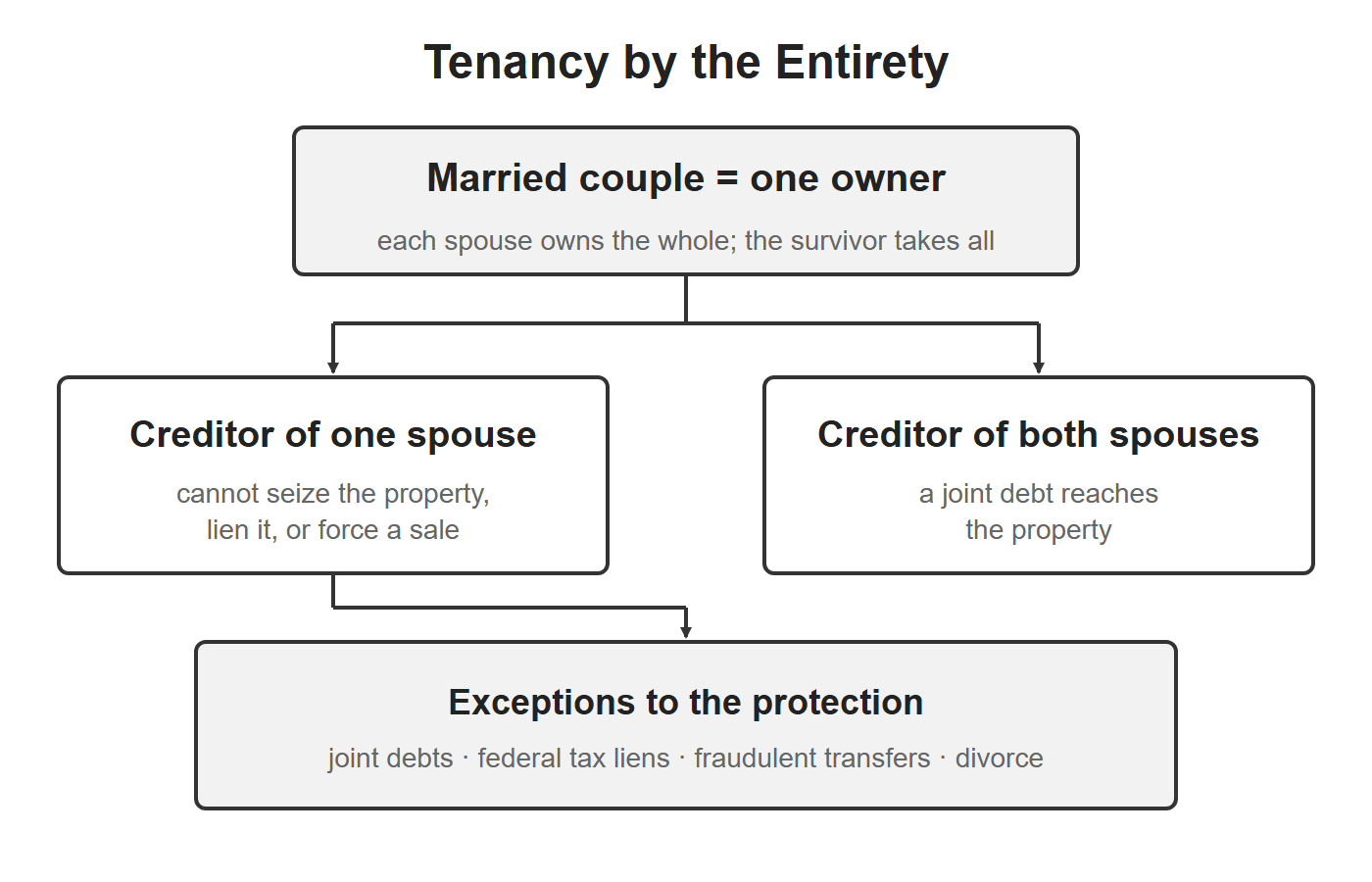
Tenancy by the entirety is a form of joint property ownership available only to married couples. The couple holds the property as a single legal owner, and each spouse owns 100% of it. When one spouse dies, the surviving spouse automatically owns the whole property. A creditor with a judgment against only one spouse cannot seize the property, place a lien on it, or force its sale.
Twenty-four states and the District of Columbia recognize tenancy by the entirety in some form. Florida recognizes it for real estate and personal property alike, including bank accounts and business interests. Florida law also presumes that a married couple’s jointly held property is entireties property unless the title or account documents specify otherwise. Entireties protection does not extend to debts both spouses owe jointly.
How Does Tenancy by the Entirety Protect Assets from Creditors?
Tenancy by the entirety protects assets because a creditor of one spouse has nothing to take. The debtor spouse owns no separate share that the creditor can seize. Florida’s entireties protection is among the strongest in the twenty-four states and the District of Columbia that recognize the doctrine, and entireties titling is a central part of Florida asset protection planning for married couples.
Florida law treats a married couple holding entireties property as a single owner. Joint tenancy with right of survivorship works differently. Each JTWROS owner holds a separable half interest that the owner’s creditors can reach. A spouse who owes a debt cannot transfer entireties property without the other spouse’s consent, and a creditor cannot force a transfer that the debtor spouse could not make alone.
If only one spouse owes the debt, entireties property is fully protected. A creditor with a judgment against the husband alone cannot garnish the couple’s joint bank account, levy against their jointly titled real estate, or seize their jointly owned investments. The creditor must wait until the tenancy ends, whether through death, divorce, or agreement, to reach the property.
The protection fails when both spouses owe the same debt to the same creditor. A single joint judgment against both spouses permits the creditor to execute against entireties property. Two separate judgments against each spouse on separate causes of action do not create a joint debt, even if both judgments are held by the same creditor.
The mistakes we see most often are unnecessary joint debts (both spouses signing a personal guarantee when the lender only required one, or co-signing a business lease together). Either act creates the joint creditor that entireties ownership cannot defeat. Married couples with liability exposure concentrated in one spouse should keep every loan, guarantee, and lease in that spouse’s name alone whenever the counterparty allows it.
Speak With Our Attorneys
Alper Law has helped clients protect their assets since 1991. Consultations are confidential, by phone or Zoom, and usually available within one business day.
Book a Consultation
Requirements for Tenancy by Entireties
Florida common law requires six elements, called “unities,” for entireties ownership to exist:
- Unity of possession requires both spouses to have equal ownership and control.
- Unity of interest requires identical ownership shares.
- Unity of title requires both interests to originate in the same document.
- Unity of time requires both spouses to acquire their interests simultaneously.
- Unity of survivorship means the property passes automatically to the surviving spouse at death.
- Unity of marriage requires the owners to be legally married when they take title.
The unities still govern most property. A couple who buys property together before marriage and then marries does not retroactively convert their joint tenancy into tenancy by the entirety, because the unity of marriage was absent when they took title.
Bank accounts are now the exception. In Loumpos v. Bank One, 423 So. 3d 856 (Fla. 2025), the Florida Supreme Court held that a joint spousal account can be entireties property even though only one spouse opened it. That is because Section 655.79’s presumption does not depend on the unities of time and title.
An account opened by one spouse and later retitled in both spouses’ names no longer fails on the time-and-title requirement, and a couple can defend it if a creditor attacks. Reliable planning still starts with a new account titled as tenants by the entirety from day one.
The Loumpos holding covers deposit accounts at banks and credit unions. It does not reach brokerage accounts or other personal property, where the unities still control. For real estate, section 689.11 lets one spouse deed property directly to both spouses as tenants by the entirety.
An entireties account must be opened and titled that way at the bank. The signature card carries the designation, and the deposit agreement contains no disclaimer. A Florida married couple can hold property three ways: tenancy by the entirety, tenancy in common, or joint tenancy with right of survivorship. Only the entireties form keeps a creditor of one spouse away from the whole asset. Florida is not a community property state: marriage alone does not make property jointly owned, so a couple who wants entireties ownership has to title the asset that way.
Presumption of Entireties Ownership
Florida presumes that property a married couple owns jointly, real or personal, is held as tenants by the entirety unless the couple has expressly indicated otherwise. Florida has presumed entireties ownership of real property for a century. The Florida Supreme Court extended that presumption to bank accounts in 2001 in Beal Bank, SSB v. Almand & Associates, 780 So. 2d 45.
Under Beal Bank, the account documents decide how strong the presumption is. An account that both spouses open with an express tenants-by-the-entirety designation is an entireties account, and the designation ends the inquiry. If the signature card says joint tenants with right of survivorship, or says nothing about ownership, the presumption still favors entireties ownership, and the creditor carries the burden of disproving it. For a deposit account the unities no longer condition that presumption: § 655.79 as construed in Loumpos supplies it even where one spouse opened the account alone.
When the financial institution offers entireties titling and the account holders select a different option, the presumption runs against entireties ownership. A married couple who checks the JTWROS box when a tenants-by-the-entirety option is available has affirmatively chosen against entireties protection.
The Florida Legislature codified part of this analysis in § 655.79. Under that statute, any deposit account held by a married couple is a tenancy by the entirety unless otherwise specified in writing. A 2023 appellate decision in Storey Mountain LLC v. George clarified that “otherwise specified in writing” includes the bank’s own customer agreement. If the deposit contract disclaims entireties ownership, that disclaimer overcomes the statutory presumption even if the signature card is silent.
In Loumpos, decided December 2025, the Florida Supreme Court held that the 2008 amendment to § 655.79 created an entireties presumption that survives even when the unities of time and title are missing. A joint spousal account is an entireties account unless the account documents specify a different form of ownership, even if one spouse opened it alone and added the other later.
For planning, a couple protects an existing individual account by opening a new account with an express entireties designation and transferring the funds. The Loumpos decision helps a couple defend an account that was already converted when a creditor attacks it; opening the account correctly in the first place avoids the fight. Florida’s entireties case law has moved steadily toward protecting married couples, from Beal Bank in 2001 through Loumpos in 2025.
What Property Qualifies for Tenancy by the Entirety Protection?
Tenancy by the entirety in Florida covers real estate, bank accounts, brokerage accounts, vehicles, and business interests, though the requirements and presumptions differ by asset type.
Real Estate
Florida real estate carries the strongest presumption of entireties ownership. A deed to a married couple is presumed to create tenancy by the entirety. A deed reciting “as tenants in common” names a different estate and defeats the presumption. Florida courts have not decided whether a deed reciting “as joint tenants with right of survivorship” does the same. Section 689.11 permits one spouse to convey real property directly to both spouses as tenants by the entirety, so no intermediary is needed and the time and title unities are satisfied by that single deed.
Entireties real estate keeps its protection while the couple holds the title, and under the Florida rule the proceeds of entireties property keep their entireties character as well (Passalino v. Protective Group Securities, Inc., 886 So. 2d 295 (Fla. 4th DCA 2004)). The exception is a lien one spouse created. In Grossfeld v. Security National Mortgage Co., No. 3D23-600 (Fla. 3d DCA 2024), a lender holding a junior mortgage the husband alone had signed took the foreclosure surplus up to its debt, because the sale severed the unities and its lien attached.
Bank Accounts
Bank accounts are protected under § 655.79 as construed in Loumpos, but the statute’s own exception still applies. The account is entireties property “unless otherwise specified in writing,” and the bank’s deposit agreement counts as that writing. A bank whose customer agreement disclaims entireties ownership defeats the presumption even for an account that looks like an ordinary joint marital account. Married couples should read the ownership provisions in the bank’s customer agreement and confirm it does not reject entireties status.
Ownership and timing failures also defeat the estate. In re Planas (Bankr. S.D. Fla. 1996) held that accounts naming a third-party co-owner or authorized signer were not entireties property, and In re Caliri (Bankr. M.D. Fla. 2006) held that accounts the couple opened before marrying failed the unity of marriage.
Some banks’ signature cards offer no entireties option. Under Beal Bank, a couple at such a bank may prove entireties intent by other evidence, and under § 655.79 the account is still presumed entireties property unless a writing says otherwise. Among the banks that offer tenancy by the entirety accounts with the designation on the signature card, practice varies. Some recognize entireties ownership by default for Florida spouses, while others default to survivorship unless the couple asks.
Brokerage and Investment Accounts
Brokerage and investment accounts fall outside § 655.79, which covers only deposit accounts at banks and credit unions, so the common-law unities and the Beal Bank presumptions still control there. Most major brokerages offer an entireties option on the account application, and where a firm offers both a rights-of-survivorship option and a separate entireties option, selecting the wrong one is an affirmative disclaimer.
Shares in a closely held corporation can be issued or assigned to both spouses as tenants by the entireties, and the corporation’s own stock records are where that ownership has to appear.
Automobiles
Automobiles can be owned as tenants by the entirety only if the title uses the word “and” between the spouses’ names. Under § 319.22(2)(a), a title that lists the spouses in the alternative with “or” is a joint tenancy, even between husband and wife, and either co-owner can sign the vehicle away alone. Florida’s dangerous instrumentality doctrine adds a separate risk: anyone listed on a vehicle title can be liable for injuries caused by any driver. Married couples should generally title vehicles in only one spouse’s name rather than jointly.
LLC Membership Interests
LLC membership interests can be owned as tenants by the entirety if the operating agreement expressly provides for it. Both spouses must have equal management rights, equal economic interests, and survivorship provisions. Florida courts have not squarely decided whether two spouses who hold a membership interest as tenants by the entirety make the LLC multi-member under § 605.0503, the charging-order statute. Until they do, a couple should not count on entireties ownership alone to make the charging order a creditor’s exclusive remedy; against a single-member LLC, it is not.
A licensed professional who wants a non-licensed spouse as co-owner must use a standard LLC under chapter 605; chapter 621 limits membership in a professional LLC to licensed individuals. The professional’s license attaches to the individual, and a standard LLC needs no license of its own.
Exceptions to Tenancy by the Entirety Protection
Under Florida law, joint debts, federal tax liens, fraudulent transfers, and divorce each override or end entireties protection.
Joint Debts
Joint debts are the main exception: when both spouses are liable on a single obligation, the creditor can reach entireties property. Mortgages both spouses signed, co-signed credit cards, and personal guarantees both spouses executed are the usual sources. A creditor who sues the husband for breach of contract and then separately sues the wife for unjust enrichment still holds two individual judgments and cannot execute against entireties property.
Federal Tax Liens
The Supreme Court held in United States v. Craft, 535 U.S. 274 (2002), that a spouse’s interest in entireties property is “property” the federal tax lien can attach to. Florida’s rule that a creditor of one spouse cannot reach entireties property does not bind the IRS. The IRS can levy against the tax-debtor spouse’s interest in any entireties asset, and the federal exception to entireties protection extends to both real and personal property.
If the IRS places a lien on entireties property and the tax-debtor spouse dies first, the lien is extinguished, and the surviving spouse takes full ownership free of the deceased spouse’s federal tax obligation. If the non-debtor spouse dies first, the lien follows the property into the debtor’s sole ownership.
Fraudulent Transfers
A spouse who converts individually owned assets into entireties property to hinder, delay, or defraud creditors risks having the transfer reversed under Florida’s Uniform Fraudulent Transfer Act. For real estate and tangible property, the remedy is a reconveyance of title back to the debtor. For cash, a creditor who proves the transfer can obtain a money judgment against the non-debtor spouse for the value received. Courts apply equitable principles to that remedy: a spouse who had no control over the account, wrote no checks, and did not direct the transfer may avoid personal liability.
Divorce
A final judgment of dissolution ends the tenancy. Section 689.15 then converts tenancy by the entirety into tenancy in common, and each former spouse’s separate 50% interest is exposed to that spouse’s individual creditors. The protection lasts until the judgment is entered, so any planning for the debtor spouse’s post-divorce exposure, including the terms of the marital settlement agreement, has to be done before then.
What Are the Disadvantages of Tenancy by the Entirety?
The main disadvantage of tenancy by the entirety is that the protection ends at the moments exposure is often highest: the death of a spouse, a divorce, or a debt both spouses owe.
When the first spouse dies, the survivor takes full title automatically and the entireties protection ends at that moment. The property becomes exposed to the surviving spouse’s individual creditors and, at the survivor’s later death, passes through the survivor’s estate. A couple relying on entireties ownership alone has no protection plan for the surviving spouse.
Entireties ownership also constrains estate planning. The property must pass outright to the surviving spouse; directing it into a children’s trust requires severing the tenancy while both spouses are alive. Second marriages create the sharpest conflict, because entireties titling routes the asset to the current spouse regardless of what a will or trust says.
Converting separately owned assets into entireties property has a divorce consequence: retitling makes the asset presumptively marital, subject to equal division if the marriage ends. A spouse who converts an inheritance into an entireties account for creditor protection has likely converted it into a divisible marital asset at the same time.
Tenancy by the Entirety for Non-Residents
Tenancy by the entirety follows the property’s location. A married couple living in another state who own Florida real estate jointly still receive Florida’s entireties protection, because real property is governed by the law of the state where it sits.
The reverse is also true. A Florida couple who jointly own rental property in Georgia, a state that does not recognize tenancy by the entirety, get no entireties protection for that property.
Florida financial accounts at Florida-based banks are governed by Florida law. National banks with branches in multiple states, however, typically treat an account as located at the branch where it was opened. Couples relocating to Florida should open new joint accounts at a Florida branch to make sure entireties protection applies.
Can Tenancy by the Entirety Be Preserved in a Trust?
Sometimes: entireties property can keep its protection inside a carefully drafted joint revocable trust, but Florida courts have not settled the question, and no Florida statute expressly preserves it. When a married couple deeds their home to the trustee of their joint living trust, title moves to the trustee, and the entireties protection can be lost.
In In re Givans, a bankruptcy court held that entireties protection ended when a couple deeded property into their joint revocable trust, because a trust is not a married individual and cannot satisfy the unity of marriage. Both spouses served as trustees there, and the children held a present interest of their own from the moment of the transfer. Other decisions have suggested that both spouses serving as joint trustees with equal control can preserve entireties character.
The safest way to draft a joint trust that holds entireties property is to include an entireties savings clause, limit control to both spouses acting together, and name no other beneficiary during the couple’s joint lifetimes. Standard living trust forms rarely include any of those terms.
How Does Tenancy by the Entirety Work in Bankruptcy?
When one spouse files for bankruptcy alone, the trustee cannot reach entireties property to pay that spouse’s individual creditors. Section 522(b)(3)(B) preserves the exemption for debtors in states like Florida that have opted out of the federal exemption scheme. The exemption covers the full value of the property with no dollar cap, which makes it one of the strongest exemptions available in bankruptcy.
The exemption also follows the property. A couple who recently moved to Florida can claim it for Florida entireties property right away, even though the 730-day residency rule would still send them to their old state’s law for every other exemption.
The joint-debt exception still applies in bankruptcy. The trustee can sell entireties assets to pay a creditor both spouses owe. A married debtor with large entireties holdings and mostly individual debts therefore usually files alone rather than jointly with the other spouse.
Practical Planning for Entireties Ownership
Tenancy by the entirety protects the most when one spouse carries the liability exposure and the couple holds its most valuable assets in both names as tenants by the entirety. A married couple in Florida should check their titling from time to time. Every jointly owned asset should meet the entireties requirements, and no account agreement should disclaim entireties ownership.
A couple whose liability is joint gains little from entireties ownership. Spouses who both owe the same lender, or who are sued together on the same claim, face a creditor who can take one judgment against both of them, and a joint judgment reaches entireties property. Couples in that situation look to other structures, such as LLCs and offshore trust planning, in addition to entireties titling.
Tenancy by the entirety does not replace liability insurance. It protects assets after a judgment but does nothing to prevent the judgment or cover litigation costs. Other Florida exemptions cover what entireties ownership cannot: Florida’s homestead exemption protects the residence even against a judgment both spouses owe, and the head of household exemption protects a debtor spouse’s wages from garnishment.